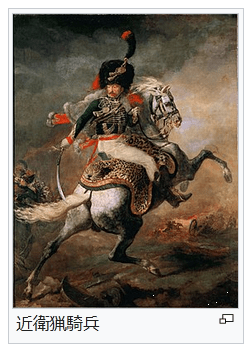
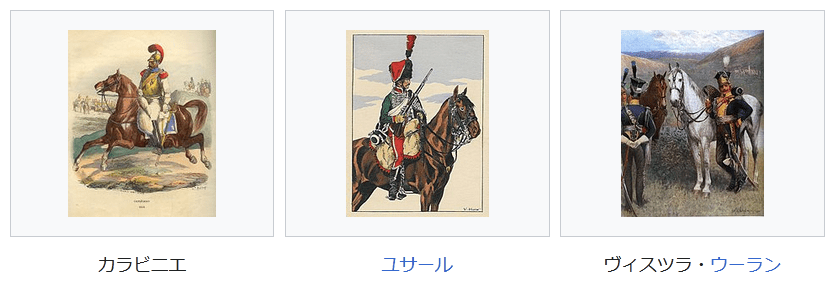
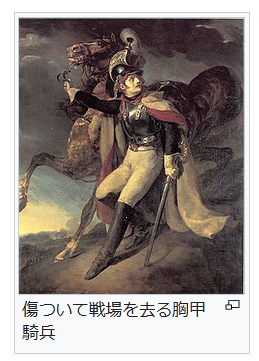
近衛騎兵は1804年に創設され、猟騎兵連隊(Chasseurs-à-Cheval)と騎馬擲弾兵連隊(Grenadiers-à-Cheval)の2つの連隊と精鋭集団であるジャンダルム(Gendarmes)大隊およびマムルーク(Mamelukes)大隊があった。1806年に3番目の連隊として皇帝近衛竜騎兵連隊(Régiment de Dragons de la Garde Impériale、後の皇妃近衛竜騎兵連隊)が追加された。1807年のポーランド方面作戦に続いて、ポーランド槍騎兵連隊(Régiment de Chevau-Légers de la Garde Impériale Polonais、皇帝近衛ポーランド軽騎兵連隊)が追加された。1810年にはもう一つの槍騎兵連隊がフランスとオランダの新兵を編入して創設された。これを第2皇帝近衛軽騎馬槍騎兵連隊(2e Régiment de Chevau-Légers Lanciers de la Garde Impériale)あるいは赤い槍騎兵連隊と呼んだ。1812年には第三の軽槍騎兵連隊が創設され、また、偵察兵連隊は1813年の末に創設された。
1807年に皇帝近衛竜騎兵連隊(Regiment de Dragons de la Garde Impériale)として創設され[10]、翌年皇妃ジョセフィーヌに敬意を表して改称された。

この連隊に入るには、少なくとも6年(後に10年)の軍歴があり、最低2回の方面作戦に参加し、勇猛さで表彰されており背の高さ173 cm以上(騎馬擲弾兵連隊よりやや低い)である必要があった。30個あった正規竜騎兵連隊からは1回の編入が1個連隊当たり12人までとされ、後に10人までに減らされた。他の近衛連隊からの志願者も編入を認められた。
この連隊は戦闘用というよりも儀礼用であり、戦闘に参加する機会は滅多になかったので[10]、入隊を求める競争が激しかった。赤い槍騎兵と同様、古参近衛隊と新規近衛隊の大隊があり、最後まで皇帝とともにあった。
近衛軽槍騎兵(Chevau-Légers-Lanciers de la Garde Impériale)[11]
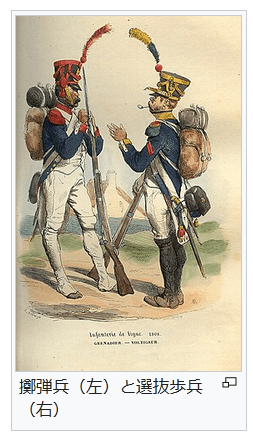
歩兵は大きく2つに分けられた。1つは戦列歩兵(Infanterie de Ligne)であり、もう1つは軽歩兵(Infanterie Légère)であった。
戦列歩兵
戦列歩兵は大陸軍の大部分を占めていた。
1803年、ナポレオンは連隊という言葉を復権させた。フランス革命中のことば半旅団(demi-brigade、2個で1個旅団となり王立という意味合いがなかった事実による)は、暫定的な部隊や補助部隊にのみ使われるようになった。大陸軍の創設時、89個戦列歩兵連隊(Régiments de Ligne)があったが、この数はフランスの県の数であった。最終的には156個連隊となった。
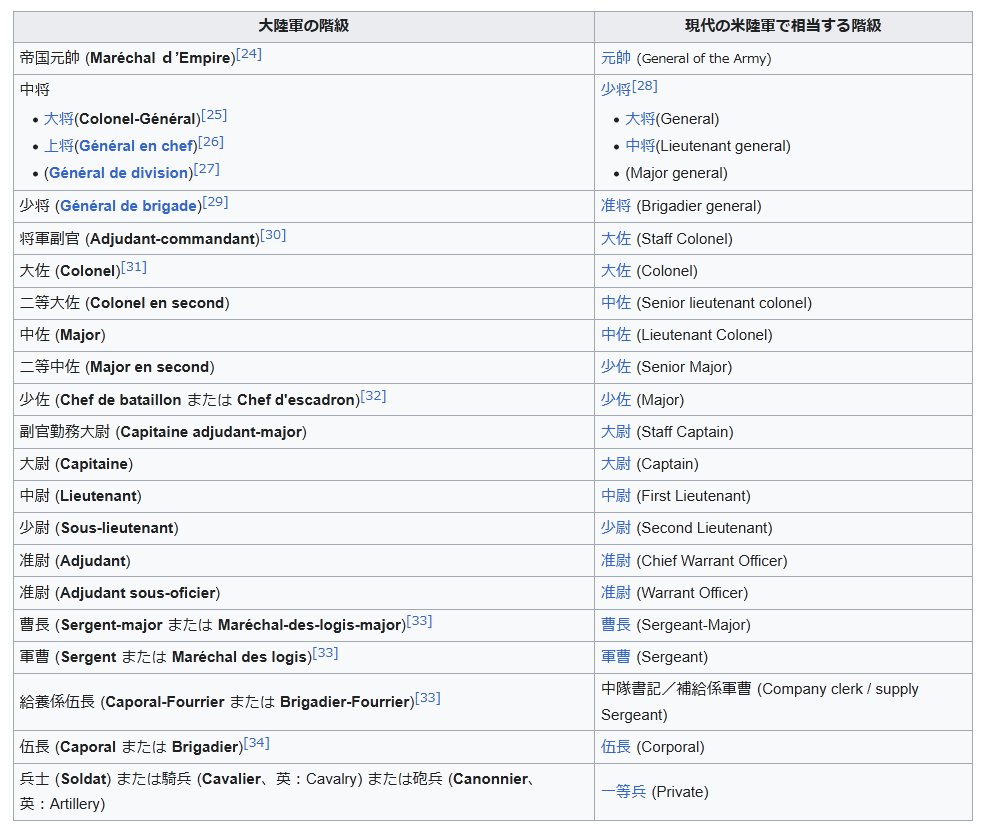
その能力を発揮できる場を与えられれば、能力のある者は数年間で頂点まで辿り着けた。他の軍隊であれば数十年掛かったであろう。身分の低い兵士ですら彼の軍嚢に元帥杖を持てるといわれた。下の表は現在の米陸軍と対照した階級のリストである。またギャラリーには頂点まで登った人物を示す。なお、当時のフランス軍では1788年に准将(仏:Brigadier des armées du roi)が廃止されたため、将官は少将と中将の二階級のみである。
大陸軍の階級 現代の米陸軍で相当する階級
帝国元帥 (Maréchal d’Empire)[24] 元帥 (General of the Army)
中将
大将(Colonel-Général)[25]
上将(Général en chef)[26]
(Général de division)[27]

少将[28]

大将(General)
中将(Lieutenant general)
(Major general)
^ Elting, John R.:"Swords Around A Throne.", pages 60-65. Da Capo Press, 1997
^ Tirailleurs de la Garde Imperiale: 1809-1815, Accessed March 16, 2006
^ Napoleon's Guard Infantry - Moyenne Garde, Accessed March 16, 2006
^ Uniform of the Grenadiers-a-Pied de la Garde, Accessed March 16, 2006
^ Foot Grenadiers in the Imperial Guard, Accessed March 16, 2006
^ Uniforms of the Chasseurs-a-Pied de la Garde, Accessed March 16, 2006
^ FUSILIERS DE LA GARDE 1806 - 1814 ARMEE FRANCAISE PLANCHE N" 101, Accessed March 16, 2006
^ Grand Tenue - Marins de la Garde, Accessed March 16, 2006
^ By Order of the Commander-in-Chief: the Origin of the Guides-a-cheval, Accessed March 16, 2006
^ a b c d e f g 『戦闘技術の歴史4 ナポレオンの時代編』創元社。
^ Napoleon's Polish Lancers, Accessed March 16, 2006
^ a b c d e f g h i j k l m n o 『図解 ナポレオンの時代武器防具戦術大全』レッカ社。
^ a b 戦略戦術兵器事典3 ヨーロッパ近代編. 学研. pp. 11
^ a b c d e f g h i j k l m n o p q r s t u v w x y z aa ab 近世近代騎兵合同誌. サークル騎兵閥. pp. 41,40,42,43
^ a b c d e f g h i j k l m n o p q 兵士の歴史大図鑑. 創元社. pp. 158,159,160
^ a b c d ナポレオンの軍隊 近代戦術の視点からさぐるその精強さの秘密. 光人社NF文庫. pp. 83,82
^ a b ナポレオンの軽騎兵 華麗なるユサール. 新紀元社. pp. 14-15,25,38
^ Mas, M.A. M., p.81.
^ 青銅砲とされる場合もあるが、いわゆる青銅(銅と錫の合金)に加え、真鍮(銅・亜鉛合金)、砲金(ガンメタル、銅・錫・亜鉛合金)製のものも含め青銅(ブロンズ)と呼ぶことがあるためである。
^ Elting, John R.:"Swords Around A Throne.", page 250. Da Capo Press, 1997
^ a b Elting, John R.:"Swords Around A Throne.", page 254-5. Da Capo Press, 1997
^ Elting, John R.:"Swords Around A Throne.", page 186, 194. Da Capo Press, 1997
^ Elting, John R. Swords Around A Throne. Da Capo Press, 1997. Pg.387.
^ 帝国元帥(仏:Maréchal de l'Empire)は階級ではない。師団将軍で傑出していると認められた者の名誉称号であり、それに応じた高い給与と特権が与えられた。ナポレオン軍の最高階級は実際には師団将軍(仏:General de division)である。 Elting, John R.:"Swords Around A Throne.", page 124. Da Capo Press, 1997.
^ 各兵科最先任の将官に対する名誉称号(『華麗なるナポレオン軍の軍服 134頁、上級大将として記述。』 マール社 リシュアン・ルスロ著 辻元よしふみ、辻元玲子監修翻訳 2014年10月20日。)であり階級ではない。帝国元帥にもなった者を除いてはルイ・ボナパルト(Louis Bonaparte)、ジュノー(Jean Andoche Junot)、ディリエ(Louis Baraguey d'Hilliers)などが叙任された。
^ 軍団長としての地位であり階級ではない。1812年廃止。その後1814年に復活するも、1848年に再び廃止された。但し階級章(四つ星)自体は軍団長たる師団将軍(仏 : Général commandant de corps d'armée)のものとして使用された。 Général または General-in-chief 参照。
^ 旧体制及び1814~1848年は中将(仏:Lieutenant-Général)
^ アメリカ軍では少将が公式の最高位の階級であり、中将および大将は役職に付随する地位とされる。
^ 旧体制及び1814~1848年は陣地総監(=少将)(仏:Maréchal de camp)
^ 将軍付き幕僚としての地位であり階級ではない。大佐(仏:Colonel)または中佐(仏:Major)が任じられた。序列は少将(仏:Général de brigade)と大佐(仏:Colonel)の間とされる事が多かった。
^ 1793~1803年は半旅団長(仏:Chef de brigade)
^ Chef d'escadronは騎乗部隊(騎兵、騎乗砲兵、憲兵、砲車牽引および輜重)の大隊長
^ a b c 後者は騎乗部隊(騎兵、騎乗砲兵、憲兵、砲車牽引および輜重)の呼称
^ フランス軍の Caporal および Brigadier は、上等兵であることが多いが第一帝政では下士官であり、その後1818年までは下士官である。
^ Todd Fisher & Gregory Fremont-Barnes, The Napoleonic Wars: The Rise and Fall of an Empire. p. 36-54
^ Fisher & Fremont-Barnes p. 54-74
^ Fisher & Fremont-Barnes p. 76-92
^ Fisher & Fremont-Barnes p. 200-209
^ Fisher & Fremont-Barnes p. 113-144
^ Insects, Disease, and Military History: Destruction of the Grand Armee
^ Fisher & Fremont-Barnes p. 145-171
^ Fisher & Fremont-Barnes p. 271-287
^ Fisher & Fremont-Barnes p. 287-297
^ Fisher & Fremont-Barnes p. 306-312
関連項目
ナポレオン戦争
参考文献
Mas, M.A. M. La Grande Armee: Introduction to Napoleon’s Army. Andrea Press, 2005.
Swords Around a Throne: Napoleon's Grande Armee, John Robert Elting. 784 pages. 1997. ISBN 0306807572
Napoleon's Line Infantry, Philip Haythornthwaite, Bryan Fosten, 48 pages. 1983. ISBN 085045512X
Napoleon's Light Infantry, Philip Haythornthwaite, Bryan Fosten, 48 pages. 1983. ISBN 0850455219
Campaigns of Napoleon, David G. Chandler. 1216 pages. 1973. ISBN 0025236601
Fisher, Todd & Fremont-Barnes, Gregory. The Napoleonic Wars: The Rise and Fall of an Empire. Oxford: Osprey Publishing Ltd., 2004. ISBN 1-84176-831-6
Royal, Republican, Imperial, a History of the French Army from 1792-1815: Vol 1 - Infantry - History of Line Infantry (1792-1815), Internal & Tactical Organization; Revolutionary National Guard, Volunteers Federes, & Compagnies Franches; and 1805 National Guard., Nafziger, George. 98 pages. (https://archive.is/20121220114621/http://home.fuse.net/nafziger/NAFNAP.HTM)
Royal, Republican, Imperial, a History of the French Army from 1792-1815: Vol 2 - Infantry - National Guard after 1809; Garde de Paris, Gendarmerie, Police, & Colonial Regiments; Departmental Reserve Companies; and Infantry Uniforms., Nafziger, George. 104 pages. (https://archive.is/20121220114621/http://home.fuse.net/nafziger/NAFNAP.HTM)
Royal, Republican, Imperial, a History of the French Army from 1792-1815: Vol 3 - Cavalry - Line, National Guard, Irregular, & Coastal Artillery, Artillery & Supply Train, and Balloon Companies., Nafziger, George. 127 pages.
Royal, Republican, Imperial, a History of the French Army from 1792-1815: Vol 4 - Imperial Guard, Nafziger, George. 141 pages. (https://archive.is/20121220114621/http://home.fuse.net/nafziger/NAFNAP.HTM)
1812: Napoleon's Fatal March on Moscow, Adam Zamoyski, ISBN 0007123752
Blundering to Glory: Napoleon's Military Campaigns (2nd edition) Owen Connelly. 254 pages. 1999. ISBN 0842027807
Napoleon on the Art of War, Jay Luvaas. 196 pages. 1999. ISBN 0684851857
The Bridges That Eble Built: The 1812 Crossing Of The Berezina, James Burbeck, War Times Journal.
With Napoleon in Russia, Armand-Augustin-Louis de Caulaincourt, , Duc de Vicence, Grosset & Dunlap, 1959
Dictionary of the Napoleonic Wars, David Chandler London 1979.
Who Was Who in the Napoleonic Wars, Phillip Haythornthwaite, London, 1998.
The Revolutionary Flying Ambulance of Napoleon's Surgeon, Capt. Jose M. Ortiz.
The Encyclopedia Of Military History: From 3500 B.C. To The Present. (2nd Revised Edition 1986), R. Ernest Dupuy, and Trevor N. Dupuy.
Memoirs of the Duke Rovigo
The Journal of the International Napoleonic Society
Supplying War: Logistics From Wallenstein to Patton, 2nd Edition, Martin van Crevald. 2004. ISBN 0521546575
Napoleonic Artillery:Firepower Comes Of Age, James Burbeck. War Times Journal
Napoleon's Elite Cavalry: Cavalry of the Imperial Guard, 1804-1815, Edward Ryan with illustrations by Lucien Rousselot, 1999 , 208 pages ISBN 1853673714
外部リンク ウィキメディア・コモンズには、大陸軍 (フランス)に関連するメディアがあります。
French website displaying flags of the Grande Armee
Soldiers of Fortitude: The Grande Armee of 1812 in Russia by Major James T. McGhee
French Heavy and Light Cavalry (Lourde et Legere Cavalerie)[リンク切れ]
French article on Chappe telegraphs, Les Telegraphes Chappe, l'Ecole Centrale de Lyon
Uniforms of Napoleon's Guard
Understanding the Conditions and Components of Warfighting
Amos C Fox
The Present and Future of War Fighting? ? The RUSI Journal
Pages 10-18 | Received 11 Dec 2021, Accepted 10 Mar 2022, Published online: 11 Apr 2022
エイモス・C・フォックス(Amos C Fox)は、独立した軍事アナリスト。軍事理論、戦略、代理戦争、市街戦、ロシア・ウクライナ戦争について幅広く研究し、執筆している。
要約:Abstract
20世紀の大半は、西側の軍事的思考(military thinking)において機動(manoeuvre)が優先されてきた。しかし、現代の技術の進歩は、今日の限定戦争の時代において、機動に必要な条件や構成要素を窒息させてしまった。その結果、機動は死んでしまう。エイモス・C・フォックス(Amos C Fox)は、国防・安全保障研究コミュニティはこれを嘆くのではなく、機動の死(manoeuvre’s death)を解放的な出来事として祝い、戦争遂行のための代替理論やアイデアを検討し始めるべきだと主張する。
国防・安全保障研究界で再び話題になっている「機動(manoeuvre)」。1991年の湾岸戦争での成功を受けて、この考えの人気は急上昇した。実際、この時期には、このテーマに関する最も重要な文献がいくつか生まれたロバート・R・レオンハルト(Robert R Leonhard)の「分単位での闘い:時間と兵法(Fighting by Minutes: Time and the Art of War)」と「機動の術:機動戦理論とエアランド・バトル(The Art of Maneuver: Maneuver Warfare Theory and AirLand Battle)」[1]である。
米国主導の多国籍軍がイラクの高速道路1号線に沿ってバグダッドまでひた走り、その間に行われたほぼすべての試みで機動(manoeuvre)が見られた。アンソニー・キング(Anthony King)は2020年末のポッドキャストでの討論で、そして2021年の著書「21世紀の市街戦(Urban Warfare in the Twenty-First Century)」[2]でも、「機動は死んだ(manoeuvre is dead)」とはっきりと宣言している。
キング(King)は間違っているというより正しい。当時は知られていなかったが、クウェートからイラクの高速道路1号線を北上してバグダッドに至る攻撃は、「機動の断末魔(manoeuvre’s death rattle)」を制するものだった。それ以来、機動の主張(claims of manoeuvre)のほとんどは、ずれた状況にその考えをねじ込もうとする弱々しい試みである。たとえば、「イラクの自由作戦(Operation Iraqi Freedom)」の第2次ファルージャの会戦(Second Battle of Fallujah)(2004年11月7日?2004年12月23日)は、定期的にこの罠にはまる。
1914年の著書で、英国の理論家J・F・C・フラー(J F C Fuller)は、適用された機動(manoeuvre)は「敵の正面に軍隊を集結させ、その側面を探撃することによって」達成されると要約した[11]。
とはいえ、多くの機動擁護派(manoeuvre apologists)は、機動(manoeuvre)は単なる用兵の方法(method of warfighting)ではなく、哲学であり思考プロセスであるとすぐに指摘する[12]。
戦力の経済性(economy of force)と奇襲(surprise)は、多くの軍隊で長年にわたって継承されてきた戦争の原則(principles of war)であり、根底にある機動の考え方(ideas of manoeuvre)である。
一方では、バジル・リデル・ハート(Basil Liddell Hart)の間接的アプローチは、戦わずして勝利し、自らの死傷者を最小限に抑えながら、奇襲の適用によって認知的麻痺(cognitive paralysis)を達成することが用兵の神格化(apotheosis of warfighting)であるという信念と機動(manoeuvre)を結びつけている[13]。
他方、米国の理論家ウィリアム・リンド(William Lind)(「機動戦ハンドブック(Maneuver Warfare Handbook)」の著者)は、この考えの最も熱烈な提唱者の一人であり続け、頻繁に「米海兵隊誌(Marine Corps Gazette)」に寄稿して、機動の美徳(manoeuvre’s virtues)を讃え、米海兵隊や米国防総省がもっと熱心な機動の実践者(ardent practitioners of manoeuvre)でないことを非難している[14]。
リンド(Lind)は、機動戦(manoeuvre warfare)は新しいものではないと主張する。
そのコンセプトは、紀元前371年のボイオティア戦争のレウクトラの会戦(Battle of Leuctra)にまで遡れば、目に見える形で戦争遂行に反映されているとリンド(Lind)は断言する[15]。
しかし、多くの実務家(practitioners)は、自分がこの考え方を誤解し、誤って適用していることに気づいていない。それどころか、彼らは、機動(manoeuvre)は賢明でより優れた用兵の方法(way of warfighting)であるという根拠のない主張を進める制度的なナラティブに従っている。
とはいえ、現実は戦争における機動の実用性の終わり(end of manoeuvre’s practicality in war)を指し示している。
経済学者のユルゲン・ブラウアー(Jurgen Brauer)と歴史家のフーベルト・ファン・テュイル(Hubert van Tuyll)は、機動(manoeuvre)のような経済的な用兵技法(economic warfighting techniques)はしばしば将軍の口から出てくるが、消耗に基づく戦いの形態(attrition-based forms of warfare)が戦争の結果を左右することが多いと述べている[27]。
オリヴィエ・シュミット(Olivier Schmitt)は、冷戦終結後、理論家たちがボイド(Boyd)のOODAループにネットワーク中心のイデオロギーと非線形性を加え、新たな軍事における革命(Revolution of Military Affairs)と信じるものを推進したため、西側の軍事的思考において速度がさらに重要性を増したと論じている[50]。
[1] Robert R Leonhard, Fighting by Minutes: Time and the Art of War (Westport, CT: Praeger Publishing, 1994); Robert R Leonhard, The Art of Maneuver: Maneuver Warfare Theory and AirLand Battle (Monterey, CA: Presidio Press, 1994).
[4] Joel D Rayburn and Frank K Sobchak (eds), The US Army in the Iraq War, Volume 1: Invasion, Insurgency, Civil War, 2003-2006 (Carlisle, PA: Army War College Press, 2019), pp. 344?51.
[5] King, Urban Warfare in the Twenty-First Century, pp. 123?43.
[6] Andrew Feickert, ‘U.S. Army Long-Range Precision Fires: Background and Issues for Congress’, Congressional Research Service, R46721, 16 March 2021, pp. 2?3.
[7] Ibid.
[8] Dave Philipps and Eric Schmitt, ‘Over Ukraine, Lumbering Turkish-Made Drones Are an Ominous Sign for Russia’, New York Times, 11 March 2022.
[9] Martin Blumenson, Kasserine Pass: Rommel’s Bloody, Climactic Battle for Tunisia (New York, NY: Cooper Square Press, 2000), p. 9; George S Patton, War as I Knew It (New York, NY: Houghton Mifflin Company, 1995), p. 348; John Kiszely, ‘The Meaning of Manoeuvre’, RUSI Journal (Vol. 143, No. 6, December 1998), pp. 36?37.
[10] B H Liddell Hart, Strategy (New York, NY: Meridian Books, 1991), pp. 334?37.
[11] J F C Fuller, ‘The Tactics of Penetration: A Counterblast to German Numerical Superiority’, RUSI Journal (Vol. 59, No. 438, 1914), p. 383.
[12] John Antal, ‘Thoughts About Maneuver Warfare’, in Richard D Hooker (ed.), Maneuver Warfare: An Anthology (Novato, CA: Presidio Press, 1993), p. 57.
[13] Liddell Hart, Strategy, pp. 334?37; Hooker, ‘Maneuver Warfare’, pp. 57?67.
[14] William Lind, letter to the editor, Marine Corps Gazette (Vol. 105, No. 8, August 2021), pp. 4?6.
[15] William S Lind, Maneuver Warfare Handbook (Boulder, CO: Westview Press, 1985), p. 6.
[16] Ibid.
[17] Ibid.
[18] Ibid.
[19] Ibid., p. 7.
[20] Robert M Citino, Blitzkrieg to Desert Storm: The Evolution of Operational Warfare (Lawrence, KS: University Press of Kansas, 2004), pp. 8?11.
[21] Land Warfare Development Centre, ‘Land Operations’, Army Doctrine Publication AC 71940, March 2017, pp. 5-1?5-6.
[22] Kiszely, ‘The Meaning of Manoeuvre’, p. 37.
[23] Land Warfare Development Centre, ‘Land Operations’, p. 2.
[24] US Army, Offense and Defense, Volume 1, FM 3-90-1 (Washington, DC: Government Printing Office, 2013), pp. 1-2?1-24.
[27] Jurgen Brauer and Hubert van Tuyll, Castles, Battles, and Bombs: How Economics Explains Military History (Chicago, IL: University of Chicago Press, 2008), p. 126.
[30] Sidharth Kaushal, ‘Positional Warfare: A Paradigm for Understanding Twenty-First-Century Conflict’, RUSI Journal (Vol. 163, No. 2, 2018), p. 35.
[31] Charles L Glaser, Rational Theory of International Politics: The Logic of Competition and Cooperation (Princeton, NJ: Princeton University Press, 2010), p. 43.
[32] Thomas C Schelling, The Strategy of Conflict (Cambridge, MA: Harvard University Press, 1981), p. 263.
[33] Brauer and van Tuyll, Castles, Battles, and Bombs, pp. 148?55.
[34] Ibid., pp. 129?34.
[35] Kaushal, ‘Positional Warfare’, p. 34.
[36] Peter Roberts and Sidharth Kaushal, ‘Competitive Advantage and Rules in Persistent Competitions’, RUSI Occasional Papers (April 2020), p. 1; Jakub Grygiel and A Wess Mitchell, ‘Limited War is Back’, National Interest, 28 August 2014.
[37] Andrew Bell, ‘Civilians, Urban Warfare, and US Doctrine’, Parameters (Vol. 50, No. 4, 2020), pp. 33?34.
[38] Michelle Tan, ‘Army Chief: Soldiers Must Be Ready to Fight in “Megacities”’, Defense News, 6 October 2016.
[39] Bell, ‘Civilians, Urban Warfare, and US Doctrine’, p. 33.
[40] J F C Fuller, Generalship, Its Diseases and Their Cure: A Study of the Personal Factor in Command (London: Faber and Faber Limited, 1936), p. 26.
[41] Aleksandr A Svechin, Strategy (Minneapolis, MN: East View Information Services, 1991), p. 248.
[45] Kevin M Felix and Frederick D Wong, ‘The Case for Megacities’, Parameters (Vol. 45, No. 1, 2015), p. 22.
[46] Ibid., p. 24.
[47] Ibid., p. 26.
[48] David G Chandler, The Campaigns of Napoleon (New York, NY: Simon and Schuster, 1966), pp. 144?57.
[49] Department of the Army, Operations, Field Manual 100-5 (Washington, DC: Government Printing Office, 1982), pp. 2?9.
[50] Schmitt, ‘Wartime Paradigms’, pp. 5?7.
[51] Ernie Harmon, ‘Notes on Combat Experience During the Tunisian and African Campaigns’ (unpublished).
[52] John J McGrath, Scouts Out! The Development of Reconnaissance Units in Modern Armies (Fort Leavenworth, KS: Combat Studies Institute Press, 2009), pp. 7?8.
[55] Franz-Stefan Gady, ‘Manoeuvre Versus Attrition in US Military Operations’, Survival (Vol. 63, No. 4, 2021), pp. 136?38.
[56] Townsend, ‘The Remote Sensing Revolution Threat’, p. 71.
[57] Bruce Einhorn, ‘Combat Drones Made in China Are Coming to a Conflict Near You’, Bloomberg, 18 March 2021.
[58] Choi Si-Young, ‘Military Unveils Plans for AI-Powered, Agile Army’, Korea Herald, 28 September 2021.
[59] Tom Kington, ‘Italy Funds Arming of Its Reaper Drones’, Defense News, 29 September 2021.
[60] Dan Altman, ‘Advancing Without Attacking: The Strategic Game Around the Use of Force’, Security Studies (Vol. 27, No. 1, 2018), p. 6.
[61] Dan Altman, ‘The Evolution of Territorial Conquest After 1945 and the Limits of the Territorial Integrity Norm’, International Organization (Vol. 74, No. 3, 2020), p. 492.
[62] Ibid.
[63] Altman, ‘Advancing Without Attacking’, p. 11; Frank Hoffman and Andrew Orner, ‘The Return of Great-Power Proxy Wars’, War on the Rocks, 2 September 2021.
[64] Barnes, ‘Maneuver Warfare’.
[65] Fuller, ‘Generalship’, p. 37.
[66] P W Singer and August Cole, Ghost Fleet: A Novel of the Next World War (New York, NY: Mariner Books, 2016).







 ジジイがあれこれ考えた