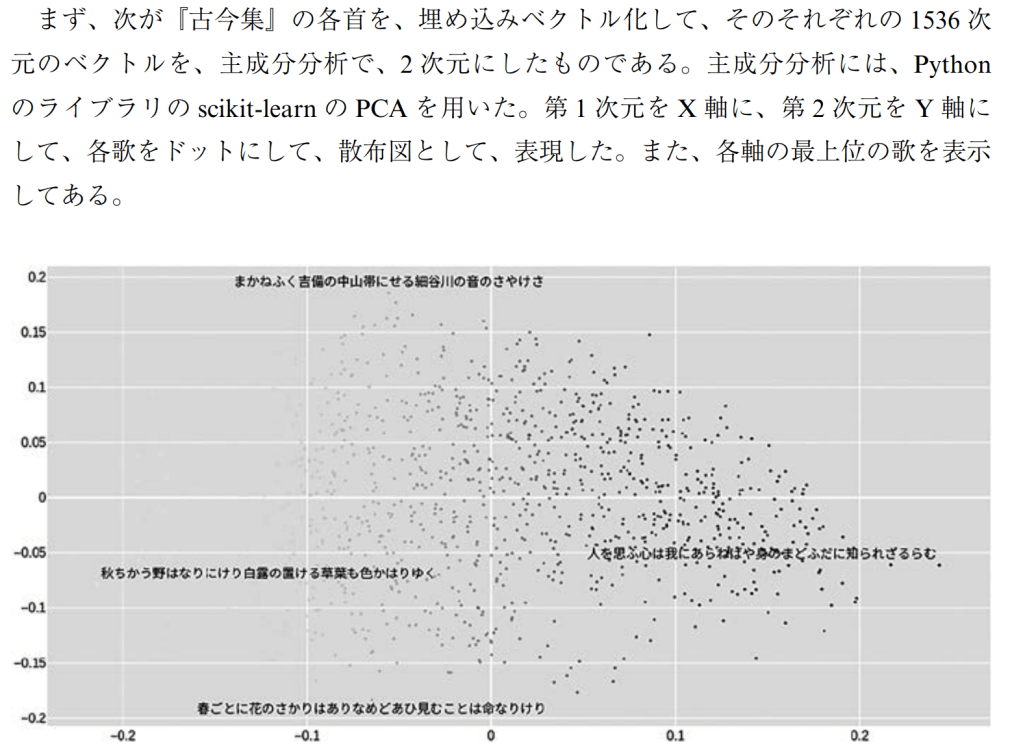
すぐわかるように、2位の「波の花沖から咲きて散りくめり水の春とは風や なるらむ」などをはじめ、非常に意味的に類似度の高い歌が選ばれていることがわかる。 これは別に『古今集』内部に限らない。たとえば、現代日本語(例、「桜の花の散るのを 惜しむ気持ちを表現する」)や英語(例、A song that expresses the feeling of regretting separa- tion from a friend.)で文を作って、それをベクトル化して比較することも可能である。 また、今回の研究で行うような、日本語と中国語の比較文学的な考察では、漢文も扱え ることは大きなメリットである。
注1 各ベクトルの数値は、最大値:0.34から、最小値:-0.64、平均0程度に分布している。 注2コサイン類似度は、コサイン距離とも言われ、ベクトルの類似度を測るもっとも一般的 な数学的手法である。ベクトルの類似度は、その相互の作る角度によるのが一般的である が、その角度のコサインを得ることで、類似度を0から1までの数値で表現できる。何次 元のベクトルであっても同様に計算できる。 注3水谷静夫(1982)では、数量化理論!E類を用いて、一首中の、複数の単語の共起情報を2 次元にすることで、その散布図において「梅」か「桜」かを弁別する方法を示している。 共起情報による数量化の方法は、現在の大規模言語モデルの方法に類似している部分があ る〇 注4ここでも、X軸の大小の方向は異なるが、これは特に意味はない。 注5 3次元の場合の各次元の数値は以下の通りである。 〔特別寄稿〕和歌集の歌風の言語的差異の記述117 固有値:[0.00796909 0.00525808 0.004523071 寄与率:[0.05528386 0.03647677 0.031377841 累積寄与率:[0.05528386 0.09176063 0.123138471 使用テキスト 『万葉集」(日本語歴史コーパス•底本(小学館新編日本古典文学全集)) 『古今集JI (日本語歴史コーパス•底本(小学館新編日本古典文学全集)) 『後撰集JI (日本語歴史コーパス•底本(正保版本「二十一代集」)) 『和漢朗詠集JI (Wikisourceテキストファイルを改編•底本不明•日本古典文学大系で校訂) 『文華秀麗集JI (浦本裕氏webサイト資料を改編•底本(岩波書店日本古典文学大系)) 引用参考文献•Webサイト一覧 浅原正幸•加藤祥(2020)rr日本語歴史コーパス」の文脈化埋め込みに基づく意味空間」「人文 科学とコンピュータシンポジウム」発表要旨、2020年12月 岡野原大輔(2023)『大規模言語モデルは新たな知能か——ChatGPTが変えた世界一J岩波書店 水谷静夫(1982)『数理言語学」現代数学レクチャーシリーズD-3 •培風館 片桐洋一(1990)『新日本古典文学大系後撰集」岩波書店、解説 川口久雄(1959)『三訂平安朝日本漢文学史の研究 中」明治書院、366-367頁 小町谷照彦(1996)「古今和歌集の成立」『岩波講座日本文学史• 2巻•九•ー〇世紀の文学」 岩波書店 近藤泰弘(2022)「平安時代語に見られるジェンダー的性質について——通時コーパスによる分 析——」日本語学会2020年度春季大会シンポジウム 菅野禮行(1999)『新編日本古典文学全集 和漢朗詠集」小学館、「和漢朗詠集をどう読むか」 渡辺秀夫(1991)『平安朝文学と漢文世界」勉誠社「6章 古今集歌に見る漢詩文的表現」 OpenAI (2023) Embeddings URL:https://platform.openai.com/docs/guides/embeddings/what-are- embeddings 謝辞:本研究で用いたコーパスは、国立国語研究所「日本語歴史コーパス」である。バージョ ンは、以下の通り。関係者の皆様に感謝申し上げます。 国立国語研究所(2023)『日本語歴史コーパス」(バージョン2023.3.中納言バージョン2.7.2) https://clrd.ninjal.ac.jp/chj/ (2023 年 9 月1日確認) また、本研究は、国立国語研究所通時コーパスプロジェクトの研究成果の一部である。 ——青山学院大学名誉教授—— (2023年10月10日 受理) 118 Studies in the Japanese Language Vol.19, No. 3 (2023) Describing Linguistic Variations in Waka Collections: An Analysis Using Large Language Models Kondo Yasuhiro Keywords: Waka, Large Language Models, Embedding Vectors, Poetic Style, Principal Component Analysis Traditionally, the investigation of the “poetic style” inherent in a collection of Waka was centered around the study of vocabulary distribution and bias. However, with the recent advancements in machine learning, research utilizing word embedding vectors such as word2vec has become feasible. In this study, we demonstrated that by applying principal component analysis to sentence embedding vectors generated by large language models, we can describe the se- mantic system at the core of Waka’s poetic style. Moreover, we observed sub- stantial differences between the “Kokin Wakashu” and “Man?y6shu” and dis- cussed the potential influence of Chinese poetry on these variations.
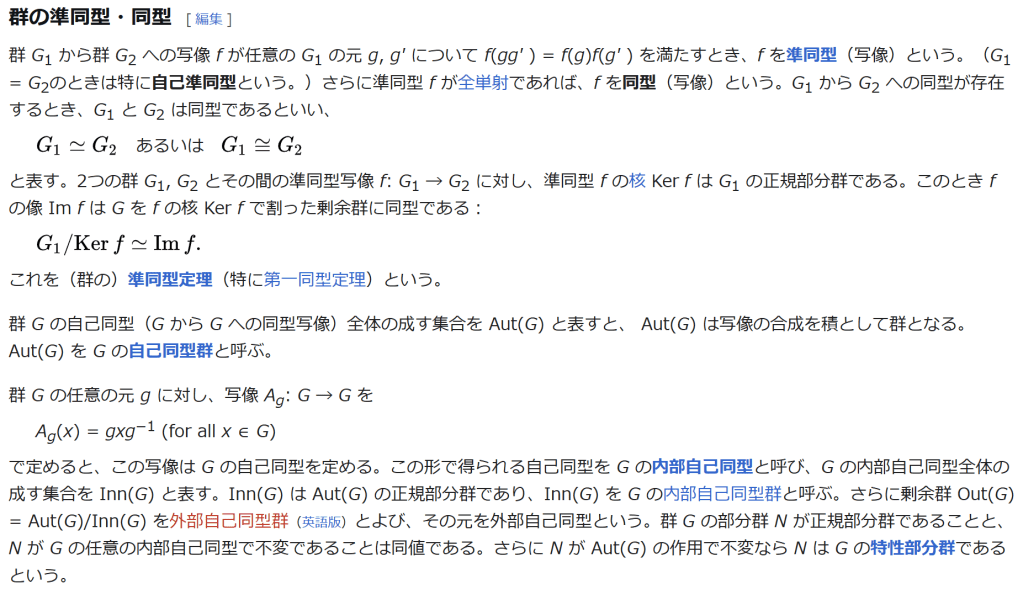
さらに準同型 f が全単射であれば、f を同型(写像)という。G1 から G2 への同型が存在するとき、G1 と G2 は同型であるといい、
G 1 ≃ G 2 {\displaystyle G_{1}\simeq G_{2}} あるいは G 1 ≅ G 2 {\displaystyle G_{1}\cong G_{2}} と表す。2つの群 G1, G2 とその間の準同型写像 f: G1 → G2 に対し、準同型 f の核 Ker f は G1 の正規部分群である。このとき f の像 Im f は G を f の核 Ker f で割った剰余群に同型である:
G 1 / K e r f ≃ I m f . {\displaystyle G_{1}/\mathrm {Ker} \,f\simeq \mathrm {Im} \,f.} これを(群の)準同型定理(特に第一同型定理)という。
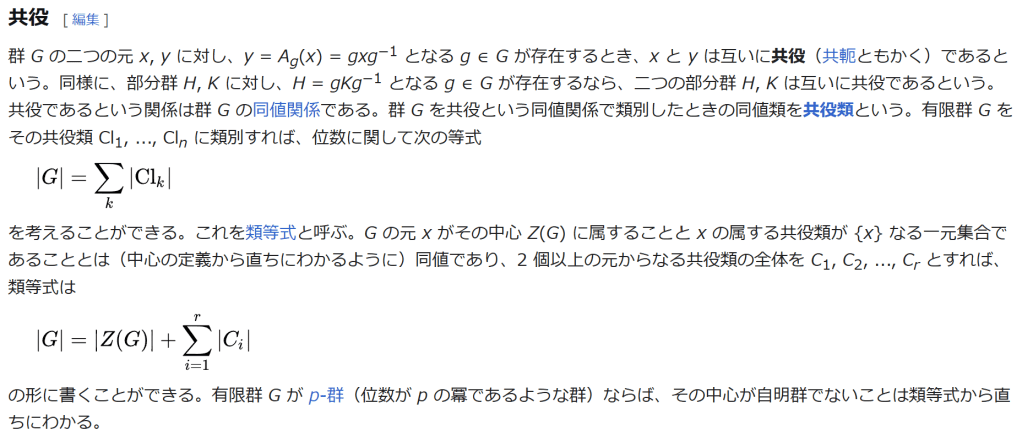
群 G の自己同型(G から G への同型写像)全体の成す集合を Aut(G) と表すと、 Aut(G) は写像の合成を積として群となる。Aut(G) を G の自己同型群と呼ぶ。
群 G の任意の元 g に対し、写像 Ag: G → G を
Ag(x) = gxg−1 (for all x ∈ G) で定めると、この写像は G の自己同型を定める。
この形で得られる自己同型を G の内部自己同型と呼び、G の内部自己同型全体の成す集合を Inn(G) と表す。
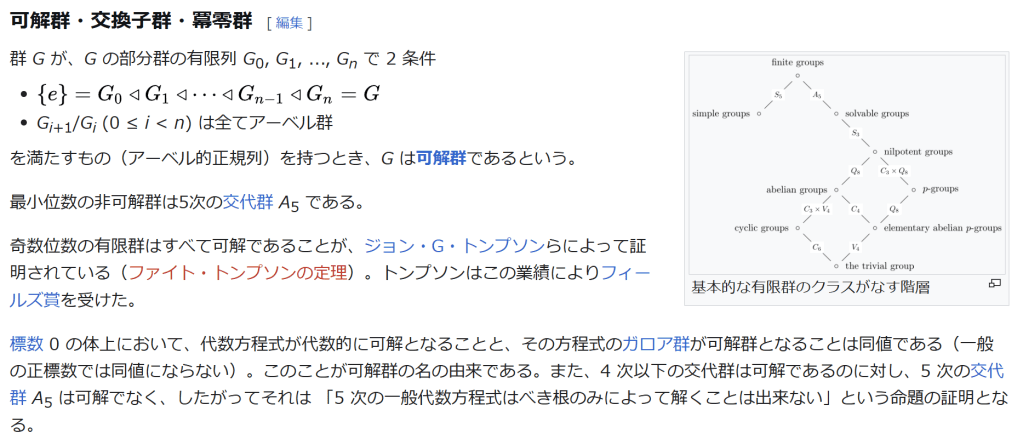
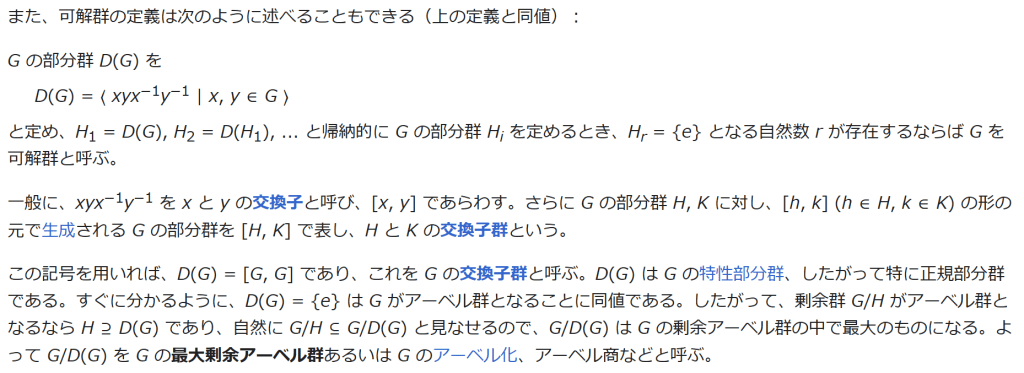
D(G) = ⟨ xyx−1y−1 | x, y ∈ G ⟩ と定め、H1 = D(G), H2 = D(H1), … と帰納的に G の部分群 Hi を定めるとき、Hr = {e} となる自然数 r が存在するならば G を可解群と呼ぶ。
一般に、xyx−1y−1 を x と y の交換子と呼び、[x, y] であらわす。
さらに G の部分群 H, K に対し、[h, k] (h ∈ H, k ∈ K) の形の元で生成される G の部分群を [H, K] で表し、H と K の交換子群という。
この記号を用いれば、D(G) = [G, G] であり、これを G の交換子群と呼ぶ。
D(G) は G の特性部分群、したがって特に正規部分群である。
すぐに分かるように、D(G) = {e} は G がアーベル群となることに同値である。
したがって、剰余群 G/H がアーベル群となるなら H ⊇ D(G) であり、自然に G/H ⊆ G/D(G) と見なせるので、G/D(G) は G の剰余アーベル群の中で最大のものになる。
よって G/D(G) を G の最大剰余アーベル群あるいは G のアーベル化、アーベル商などと呼ぶ。
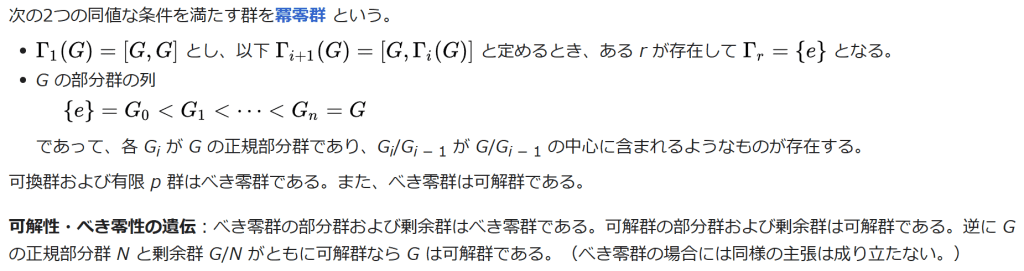
次の2つの同値な条件を満たす群を冪零群 という。
Γ 1 ( G
)
[ G , G ] {\displaystyle \Gamma _{1}(G)=[G,G]} とし、以下 Γ i + 1 ( G
)
[ G , Γ i ( G ) ] {\displaystyle \Gamma {i+1}(G)=[G,\Gamma {i}(G)]} と定めるとき、ある r が存在して Γ
r
{ e } {\displaystyle \Gamma _{r}={e}} となる。 G の部分群の列 { e
}
G 0 < G 1 < ⋯ < G
n
G {\displaystyle {e}=G_{0}<G_{1}<\cdots <G_{n}=G} であって、各 Gi が G の正規部分群であり、Gi/Gi − 1 が G/Gi − 1 の中心に含まれるようなものが存在する。
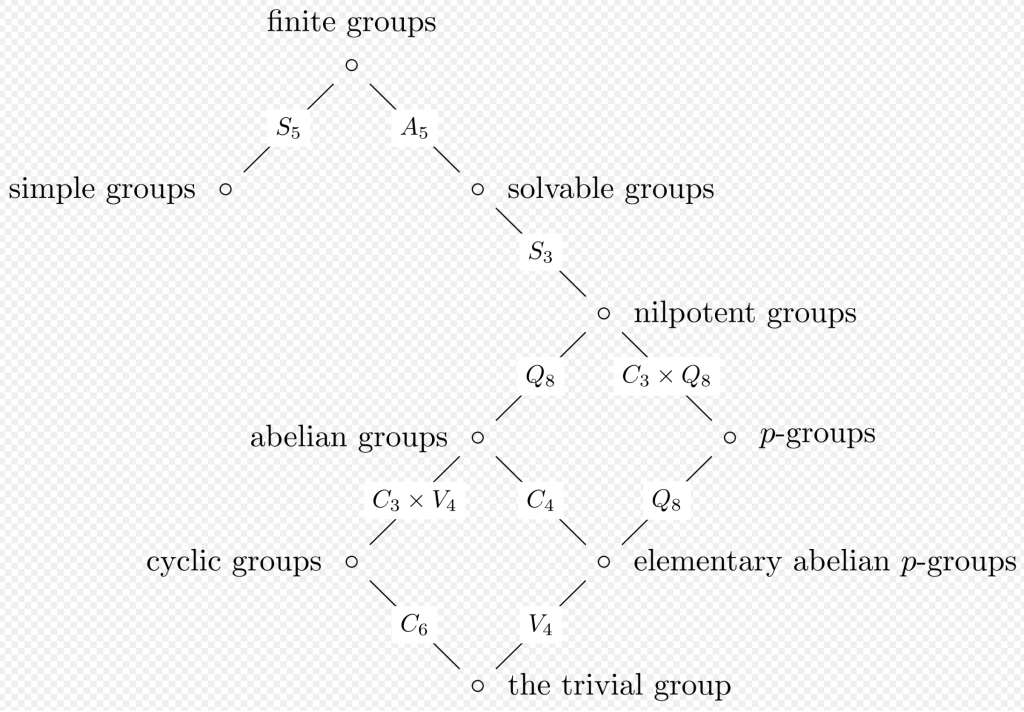
可換群および有限 p 群はべき零群である。また、べき零群は可解群である。
可解性・べき零性の遺伝:べき零群の部分群および剰余群はべき零群である。可解群の部分群および剰余群は可解群である。逆に G の正規部分群 N と剰余群 G/N がともに可解群なら G は可解群である。(べき零群の場合には同様の主張は成り立たない。)
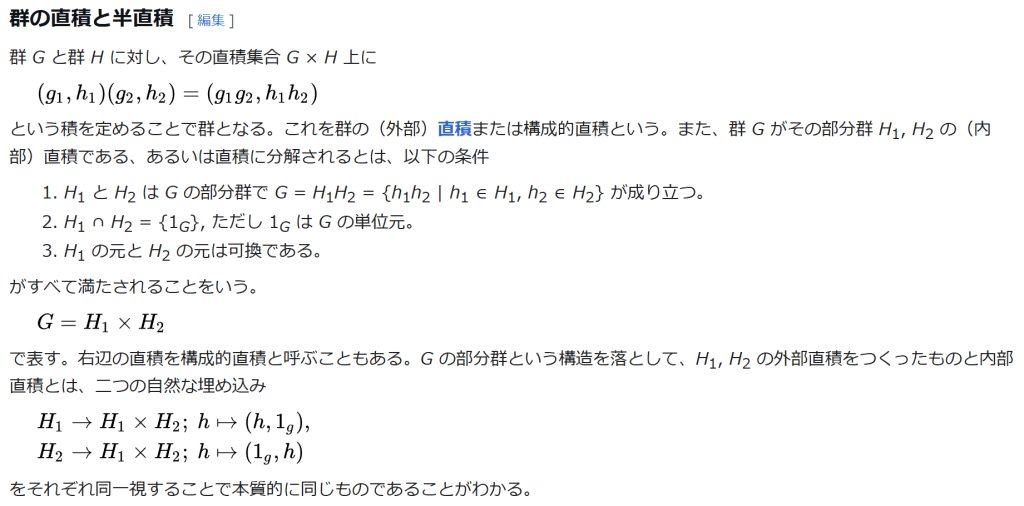
群の直積と半直積 群 G と群 H に対し、その直積集合 G × H 上に
( g 1 , h 1 ) ( g 2 , h 2
)
( g 1 g 2 , h 1 h 2 ) {\displaystyle (g_{1},h_{1})(g_{2},h_{2})=(g_{1}g_{2},h_{1}h_{2})} という積を定めることで群となる。これを群の(外部)直積または構成的直積という。また、群 G がその部分群 H1, H2 の(内部)直積である、あるいは直積に分解されるとは、以下の条件
H 1 × H 2 {\displaystyle G=H_{1}\times H_{2}} で表す。右辺の直積を構成的直積と呼ぶこともある。
G の部分群という構造を落として、H1, H2 の外部直積をつくったものと内部直積とは、二つの自然な埋め込み
H 1 → H 1 × H 2 ;
h ↦ ( h , 1 g ) , {\displaystyle H_{1}\to H_{1}\times H_{2};\ h\mapsto (h,1_{g}),} H 2 → H 1 × H 2 ;
h ↦ ( 1 g , h ) {\displaystyle H_{2}\to H_{1}\times H_{2};\ h\mapsto (1_{g},h)} をそれぞれ同一視することで本質的に同じものであることがわかる。
群 H と群 N と準同型写像 f: H → Aut(N) が与えられているとき、直積集合 N × H 上に
( n 1 , h 1 ) ( n 2 , h 2
)
( n 1 f ( h 1 ) ( n 2 ) , h 1 h 2 ) {\displaystyle (n_{1},h_{1})(n_{2},h_{2})=(n_{1}f(h_{1})(n_{2}),h_{1}h_{2})} で積を定めると群となる。これを H と N の f による半直積といい、
G
N ⋊ H {\displaystyle G=N\rtimes H} で表す。なお、この群で N は正規部分群となる。群の拡大も参照。
有限群 →詳細は「有限群 § 主要な定理」を参照
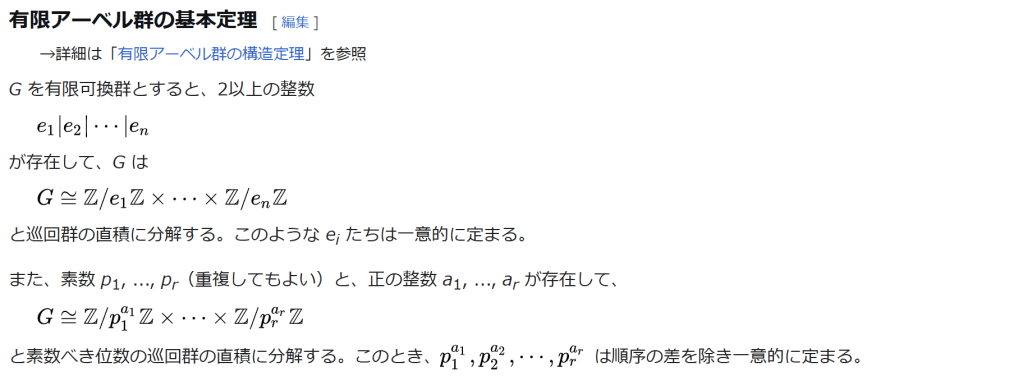
有限アーベル群の基本定理 →詳細は「有限アーベル群の構造定理」を参照
G を有限可換群とすると、2以上の整数
e 1 | e 2 | ⋯ | e n {\displaystyle e_{1}|e_{2}|\cdots |e_{n}} が存在して、G は
G ≅ Z / e 1 Z × ⋯ × Z / e n Z {\displaystyle G\cong \mathbb {Z} /e_{1}\mathbb {Z} \times \cdots \times \mathbb {Z} /e_{n}\mathbb {Z} } と巡回群の直積に分解する。このような ei たちは一意的に定まる。
また、素数 p1, …, pr(重複してもよい)と、正の整数 a1, …, ar が存在して、
G ≅ Z / p 1 a 1 Z × ⋯ × Z / p r a r Z {\displaystyle G\cong \mathbb {Z} /p_{1}^{a_{1}}\mathbb {Z} \times \cdots \times \mathbb {Z} /p_{r}^{a_{r}}\mathbb {Z} } と素数べき位数の巡回群の直積に分解する。
このとき、 p 1 a 1 , p 2 a 2 , ⋯ , p r a r {\displaystyle {p_{1}^{a_{1}},p_{2}^{a_{2}},\cdots ,p_{r}^{a_{r}}}} は順序の差を除き一意的に定まる。
コーシーの定理 →詳細は「コーシーの定理 (群論)」を参照
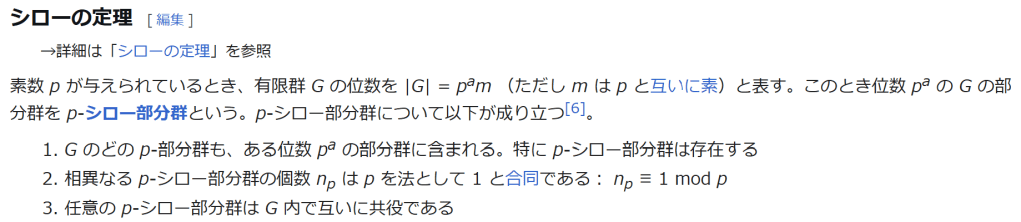
有限群 G の位数 |G| の素因数を p とするとき、位数 p をもつ G の元が存在する[5]。 シローの定理 →詳細は「シローの定理」を参照
素数 p が与えられているとき、有限群 G の位数を |G| = pam (ただし m は p と互いに素)と表す。このとき位数 pa の G の部分群を p-シロー部分群という。p-シロー部分群について以下が成り立つ[6]。
G のどの p-部分群も、ある位数 pa の部分群に含まれる。特に p-シロー部分群は存在する
相異なる p-シロー部分群の個数 np は p を法として 1 と合同である: np ≡ 1 mod p 任意の p-シロー部分群は G 内で互いに共役である
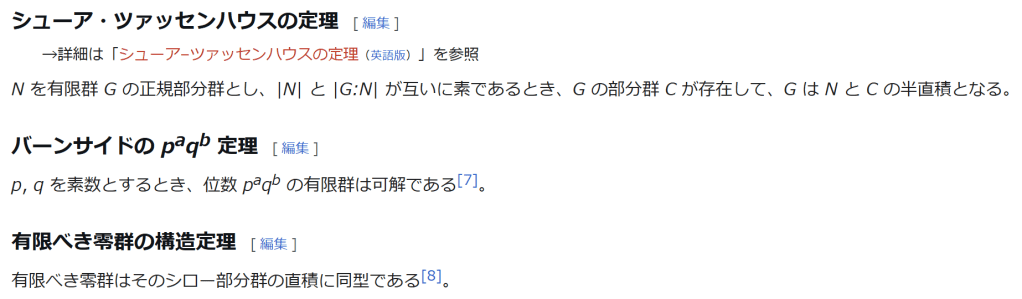
シューア・ツァッセンハウスの定理 →詳細は「シューア–ツァッセンハウスの定理(英語版)」を参照
N を有限群 G の正規部分群とし、|N| と |G:N| が互いに素であるとき、G の部分群 C が存在して、G は N と C の半直積となる。
^ a b バーコフ & マクレーン 1967, 第VI章 4. 抽象群. ^ McCune, W.W. (1993), “Single axioms for groups and Abelian groups with various operations”, Journal of Automated Reasoning 10: 1–13, doi:10.1007/BF00881862 ^ a b Robinson 1996, p. 2 ^ Robinson 1996, 1.3.1 (The Subgroup Criterion). ^ Robinson 1996, 1.6.17 (Cauchy’s Theorem). ^ Robinson 1996, 1.6.16 (Sylow’s Theorem). ^ Doerk & Hawkes 1992, p. 210. ^ Robinson 1996, 5.2.4.
参考文献
ガーレット・バーコフ、ソンダース・マクレーン『現代代数学概論』(改訂3版)白水社、1967年。NDLJP:2422244。 Doerk, Klaus; Hawkes, Trevor (1992). Finite soluble groups. de Gruyter Expositions in Mathematics. 4. Walter de Gruyter & Co. ISBN 3-11-012892-6. MR1169099. Zbl 0753.20001 Robinson, Derek J. S. (1996). A course in the theory of groups. Graduate Texts in Mathematics. 80 (Second ed.). Springer-Verlag. ISBN 0-387-94461-3. MR1357169. Zbl 0836.20001
関連項目
代数的構造 ガロア理論 物性物理 ガロア アーベル 対称性
外部リンク 『群の定義といろいろな具体例』 – 高校数学の美しい物語 数学と文化人類学の邂逅(川添充、2001年12月11日) – ウェイバックマシン(2004年6月3日アーカイブ分) Rowland, Todd; Weisstein, Eric W. “Group”. mathworld.wolfram.com (英語). group in nLab group – PlanetMath.(英語) Definition:Group at ProofWiki Kargapolov, M.I.; Merzlyakov, Yu.I. (2001), “Group”, in Hazewinkel, Michiel, Encyclopedia of Mathematics, Springer, ISBN 978-1-55608-010-4 表話編歴 群論 表話編歴 代数学 典拠管理データベース: 国立図書館 ウィキデータを編集 ドイツ チェコ カテゴリ: 群論抽象代数学数学に関する記事
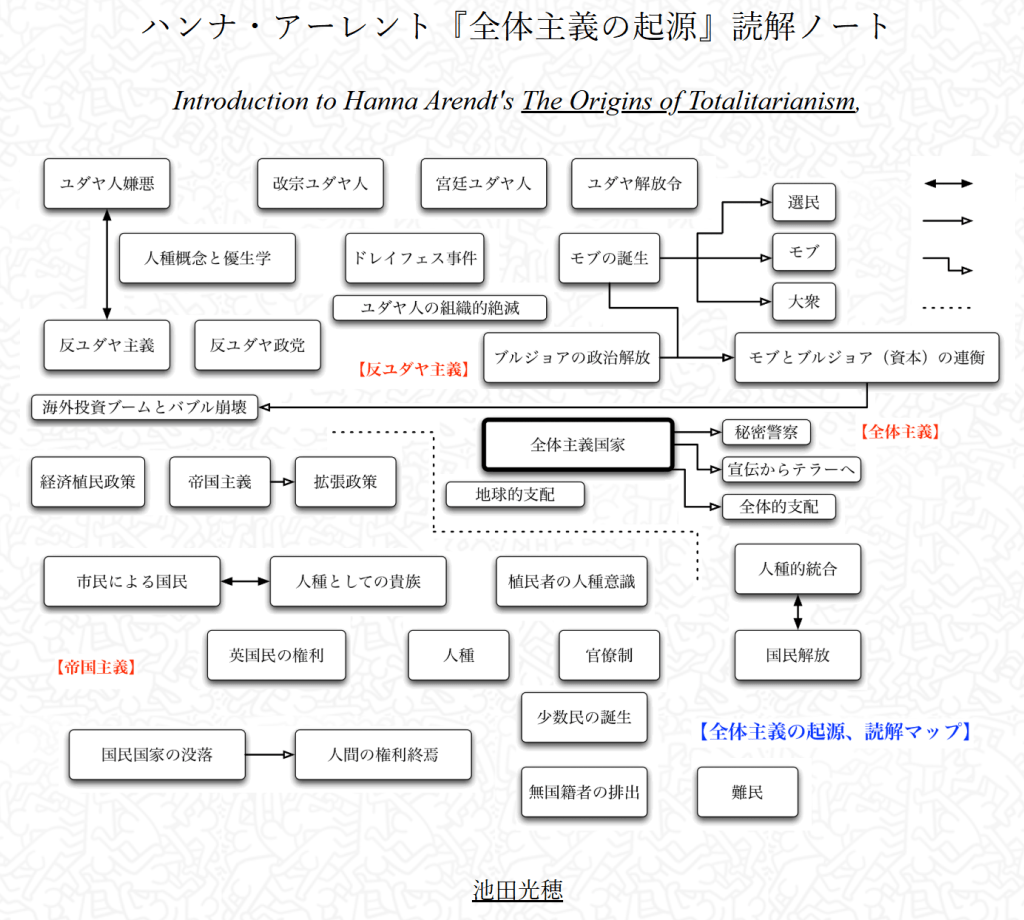
The Origins of Totalitarianism, published in 1951, was Hannah Arendt’s first major work, wherein she describes and analyzes Nazism and Stalinism as the major totalitarian political movements of the first half of the 20th century. 1951年に出版された『全体主義の起源』 は、ハンナ・アーレントの最初の主要著作であり、20世紀前半の主要な全体主義的政治運動としてナチズムとスターリニズムを記述し分析したものである。 The Origins of Totalitarianism (Die Ursprünge des Totalitarismus), 1951 veröffentlicht, war Hannah Arendts erstes großes Werk, in dem sie den Nationalsozialismus und den Stalinismus als die wichtigsten totalitären politischen Bewegungen der ersten Hälfte des 20. Jahrhunderts beschreibt und analysiert. The Origins of Totalitarianism[1] was first published in English in 1951.[1] A German translation was published in 1955 as Elemente und Ursprünge totaler Herrschaft (“Elements and Origins of Totalitarian Rule”). A second, enlarged edition was published in 1958, and contained two additional chapters, replacing her original “Concluding Remarks”.[2] Chapter Thirteen was titled “Ideology and Terror: A novel form of government”, which she had published separately in 1953.[3] Chapter Fourteen dealt with the Hungarian Revolution of 1956, entitled “Epilogue: Reflections on the Hungarian Revolution”. Subsequent editions omitted this chapter, which was published separately in English (“Totalitarian Imperialism: Reflections on the Hungarian Revolution”)[4] and German (Die ungarische Revolution und der totalitäre Imperialismus)[5] in 1958.[6] 1955年に『全体主義の起源』(Elemente und Ursprünge totaler Herrschaft)としてドイツ語訳が出版された[1]。1958年に出版された増補版では、当初の「結びの言葉」に代わって2つの章が追加された [2]。 13章は「イデオロギーと恐怖」と題された。第14章は、1956年のハンガリー革命を扱ったもので、「エピローグ」と題されている[3]。ハンガリー革 命を振り返って」と題されている。その後の版ではこの章が省略され、1958年に英語版(”Totalitarian Imperialism: Reflections on the Hungarian Revolution”)[4]とドイツ語版(Die ungarische Revolution und der totalitäre Imperialismus)[5]で別々に出版されている[6]。 The Origins of Totalitarianism[1] wurde erstmals 1951 in englischer Sprache veröffentlicht. 1955 erschien eine deutsche Übersetzung unter dem Titel Elemente und Ursprünge totaler Herrschaft”. Eine zweite, erweiterte Auflage wurde 1958 veröffentlicht und enthielt zwei zusätzliche Kapitel, die ihre ursprünglichen “Abschließenden Bemerkungen” ersetzten.[2] Kapitel dreizehn trug den Titel “Ideologie und Terror: Eine neue Regierungsform”, das sie 1953 separat veröffentlicht hatte.[3] Kapitel vierzehn befasste sich mit der ungarischen Revolution von 1956 und trug den Titel “Epilog: Reflexionen über die ungarische Revolution”. Spätere Auflagen ließen dieses Kapitel weg, das 1958 separat auf Englisch (“Totalitarian Imperialism: Reflections on the Hungarian Revolution”)[4] und Deutsch (Die ungarische Revolution und der totalitäre Imperialismus)[5] veröffentlicht wurde.[6] Like many of Arendt’s books, The Origins of Totalitarianism is structured as three essays: “Antisemitism”, “Imperialism” and “Totalitarianism”. The book describes the various preconditions and subsequent rise of anti-Semitism in central, eastern, and western Europe in the early-to-mid 19th century; then examines the New Imperialism, from 1884 to the start of the First World War (1914–18); then traces the emergence of racism as an ideology, and its modern application as an “ideological weapon for imperialism”, by the Boers during the Great Trek in the early 19th century (1830s–40s). In this book, Arendt argues that totalitarianism was a “novel form of government,” that “differs essentially from other forms of political oppression known to us such as despotism, tyranny and dictatorship”[7] in that it applied terror to subjugate mass populations rather than just political adversaries.[8][9] Further, Arendt states that, owing to its peculiar ideology and the role assigned to it in its apparatus of coercion, “totalitarianism has discovered a means of dominating and terrorizing human beings from within” [10] She further contends that Jewry was not the operative factor in the Holocaust, but merely a convenient proxy. That totalitarianism in Germany was, in the end, about terror and consistency, not eradicating Jews only.[11][9] A key concept arising from this book was the application of Kant’s phrase “Radical Evil”,[12] which she applied to the men who created and carried out such tyranny and their depiction of their victims as “Superfluous People”.[13][14]
Wie viele von Arendts Büchern ist auch The Origins of Totalitarianism in drei Essays gegliedert: “Antisemitismus”, “Imperialismus” und “Totalitarismus”. Das Buch beschreibt die verschiedenen Voraussetzungen und den anschließenden Aufstieg des Antisemitismus in Mittel-, Ost- und Westeuropa Anfang bis Mitte des 19. Jahrhunderts; dann untersucht es den Neuen Imperialismus von 1884 bis zum Beginn des Ersten Weltkriegs (1914-18); schließlich zeichnet es die Entstehung des Rassismus als Ideologie und seine moderne Anwendung als “ideologische Waffe für den Imperialismus” durch die Buren während des Großen Trecks im frühen 19. In diesem Buch argumentiert Arendt, dass der Totalitarismus eine “neuartige Regierungsform” sei, die sich “von anderen uns bekannten Formen politischer Unterdrückung wie Despotismus, Tyrannei und Diktatur wesentlich unterscheidet”[7], da er Terror zur Unterwerfung von Massenbevölkerungen und nicht nur von politischen Gegnern anwendet. [8][9] Ferner stellt Arendt fest, dass der Totalitarismus aufgrund seiner besonderen Ideologie und der ihm zugewiesenen Rolle in seinem Zwangsapparat “ein Mittel entdeckt hat, die Menschen von innen heraus zu beherrschen und zu terrorisieren” [10] Sie behauptet ferner, dass das Judentum nicht der entscheidende Faktor beim Holocaust war, sondern lediglich ein bequemer Stellvertreter. Dem Totalitarismus in Deutschland ging es letztlich um Terror und Konsequenz, nicht nur um die Ausrottung der Juden.[11][9] Ein Schlüsselkonzept, das aus diesem Buch hervorging, war die Anwendung von Kants Begriff des “radikal Bösen”[12], den sie auf die Männer anwandte, die eine solche Tyrannei schufen und ausübten, und auf ihre Darstellung ihrer Opfer als “überflüssige Menschen”[13][14]. Arendt begins the book with an analysis of the rise of antisemitism in Europe, particularly focusing on the Dreyfus affair.[11] In particular, Arendt traces the social movement of the Jewry in Europe since their emancipation by the French edict of 1792, and their special role in supporting and maintaining the nation-state, while failing to assimilate into the European class society.[15] The European Jewry’s association with the nation-state meant that their destinies were to an extent tied. As Arendt observed, “modern anti semitism grew in proportion as traditional nationalism declined, and reached its climax at the exact moment when the European system of nation-states and its precarious balance of power crashed.”[16] Nazi Germany would later exploit this antisemitism, and targeted the Jewry which was construed, among other things, as a proxy for the nation-state. In so doing, Nazism sought, among other reasons, to organize the masses to bring about the disintegration of the nation-state system, and to advance the totalitarian project which was global in its orientation.[17]
She then discusses scientific racism, and its role in colonialist imperialism, itself characterized by unlimited territorial and economic expansion.[11] That unlimited expansion necessarily opposed itself and was hostile to the territorially delimited nation-state. Arendt traces the roots of modern imperialism to the accumulation of excess capital in European nation-states during the 19th century. This capital required overseas investments outside of Europe to be productive and political control had to be expanded overseas to protect the investments. She then examines “continental imperialism” (pan-Germanism and pan-Slavism) and the emergence of “movements” substituting themselves to the political parties. These movements are hostile to the state and antiparliamentarist and gradually institutionalize anti-Semitism and other kinds of racism.
Arendt concludes that while Italian Fascism was a nationalist authoritarian movement, Nazism and Stalinism were totalitarian movements that sought to eliminate all restraints upon the power of the movement. She attributes the difference, in part, to a minimum necessary population:
Totalitarian movements depend on the sheer force of numbers to such an extent that totalitarian regimes seem impossible, even under otherwise favorable circumstances, in countries with relatively small populations…. Even Mussolini, who was so fond of the term “totalitarian state,” did not attempt to establish a full-fledged totalitarian regime and contented himself with dictatorship and one-party rule.[18]
Arendt beginnt das Buch mit einer Analyse des Aufstiegs des Antisemitismus in Europa, wobei sie sich besonders auf die Dreyfus-Affäre konzentriert.[11] Insbesondere zeichnet Arendt die soziale Bewegung des Judentums in Europa seit seiner Emanzipation durch das französische Edikt von 1792 nach, sowie seine besondere Rolle bei der Unterstützung und Aufrechterhaltung des Nationalstaates, während es ihm nicht gelang, sich in die europäische Klassengesellschaft zu assimilieren.[15] Die Verbindung des europäischen Judentums mit dem Nationalstaat bedeutete, dass ihre Schicksale in gewissem Maße miteinander verbunden waren. Wie Arendt feststellte, “wuchs der moderne Antisemitismus in dem Maße, wie der traditionelle Nationalismus abnahm, und erreichte seinen Höhepunkt genau in dem Moment, als das europäische System der Nationalstaaten und sein prekäres Machtgleichgewicht zusammenbrachen”[16] Nazi-Deutschland nutzte diesen Antisemitismus später aus und nahm das Judentum ins Visier, das unter anderem als Stellvertreter für den Nationalstaat angesehen wurde. Auf diese Weise wollte der Nationalsozialismus unter anderem die Massen organisieren, um den Zerfall des nationalstaatlichen Systems herbeizuführen und das totalitäre Projekt, das global ausgerichtet war, voranzutreiben[17].
Anschließend erörtert sie den wissenschaftlichen Rassismus und dessen Rolle im kolonialistischen Imperialismus, der seinerseits durch eine unbegrenzte territoriale und wirtschaftliche Expansion gekennzeichnet war[11] und der sich notwendigerweise gegen den territorial begrenzten Nationalstaat richtete und ihm feindlich gegenüberstand. Arendt führt die Wurzeln des modernen Imperialismus auf die Anhäufung von überschüssigem Kapital in den europäischen Nationalstaaten während des 19. Jahrhunderts zurück. Dieses Kapital benötigte Investitionen außerhalb Europas, um produktiv zu sein, und die politische Kontrolle musste auf das Ausland ausgedehnt werden, um die Investitionen zu schützen. Anschließend untersucht sie den “kontinentalen Imperialismus” (Pangermanismus und Panslawismus) und das Aufkommen von “Bewegungen”, die sich an die Stelle der politischen Parteien setzen. Diese Bewegungen sind staatsfeindlich und antiparlamentarisch und institutionalisieren allmählich den Antisemitismus und andere Formen des Rassismus.
Arendt kommt zu dem Schluss, dass der italienische Faschismus eine nationalistische autoritäre Bewegung war, während der Nationalsozialismus und der Stalinismus totalitäre Bewegungen waren, die danach strebten, alle Beschränkungen der Macht der Bewegung zu beseitigen. Sie führt den Unterschied zum Teil auf eine notwendige Mindestbevölkerung zurück:
Totalitäre Bewegungen sind in einem solchen Maße von der schieren Kraft der Zahlen abhängig, dass totalitäre Regime selbst unter sonst günstigen Umständen in Ländern mit relativ kleinen Bevölkerungszahlen unmöglich erscheinen…. Selbst Mussolini, der den Begriff “totalitärer Staat” so sehr liebte, versuchte nicht, ein vollwertiges totalitäres Regime zu errichten, sondern begnügte sich mit Diktatur und Einparteienherrschaft. The book’s final section is devoted to describing the mechanics of totalitarian movements, focusing on Nazi Germany and the Soviet Union. Here, Arendt discusses the transformation of classes into masses, the role of propaganda in dealing with the non-totalitarian world, and the use of terror, essential to this form of government. Totalitarian movements are fundamentally different from autocratic regimes, says Arendt, insofar as autocratic regimes seek only to gain absolute political power and to outlaw opposition, while totalitarian regimes seek to dominate every aspect of everyone’s life as a prelude to world domination. She states:
… Intellectual, spiritual, and artistic initiative is as dangerous to totalitarianism as the gangster initiative of the mob, and both are more dangerous than mere political opposition. The consistent persecution of every higher form of intellectual activity by the new mass leaders springs from more than their natural resentment against everything they cannot understand. Total domination does not allow for free initiative in any field of life, for any activity that is not entirely predictable. Totalitarianism in power invariably replaces all first-rate talents, regardless of their sympathies, with those crackpots and fools whose lack of intelligence and creativity is still the best guarantee of their loyalty.[19]
Arendt discusses the use of front organizations, fake governmental agencies, and esoteric doctrines as a means of concealing the radical nature of totalitarian aims from the non-totalitarian world. Near the end of the book, Arendt writes that loneliness is a precondition for totalitarian domination, with people who are socially isolated more likely to be attracted to totalitarian ideology and movements.[20]
Der letzte Abschnitt des Buches ist der Beschreibung der Mechanismen totalitärer Bewegungen gewidmet und konzentriert sich auf Nazideutschland und die Sowjetunion. Hier erörtert Arendt die Umwandlung von Klassen in Massen, die Rolle der Propaganda im Umgang mit der nichttotalitären Welt und den Einsatz von Terror, der für diese Regierungsform unerlässlich ist. Totalitäre Bewegungen unterscheiden sich grundlegend von autokratischen Regimen, so Arendt, da autokratische Regime nur danach streben, die absolute politische Macht zu erlangen und die Opposition zu ächten, während totalitäre Regime danach streben, jeden Aspekt des Lebens aller Menschen zu beherrschen, als Vorspiel zur Weltherrschaft. Sie stellt fest:
… Intellektuelle, geistige und künstlerische Initiative ist für den Totalitarismus ebenso gefährlich wie die Gangsterinitiative der Mafia, und beide sind gefährlicher als bloße politische Opposition. Die konsequente Verfolgung jeder höheren Form intellektueller Betätigung durch die neuen Massenführer entspringt mehr als ihrem natürlichen Ressentiment gegen alles, was sie nicht verstehen. Die totale Herrschaft lässt keine freie Initiative in irgendeinem Lebensbereich zu, keine Tätigkeit, die nicht völlig vorhersehbar ist. Der Totalitarismus an der Macht ersetzt unweigerlich alle erstklassigen Talente, ungeachtet ihrer Sympathien, durch jene Spinner und Dummköpfe, deren Mangel an Intelligenz und Kreativität immer noch die beste Garantie für ihre Loyalität ist.[19]
Arendt erörtert den Einsatz von Tarnorganisationen, gefälschten Regierungsstellen und esoterischen Doktrinen als Mittel, um die Radikalität der totalitären Ziele vor der nicht-totalitären Welt zu verbergen. Gegen Ende des Buches schreibt Arendt, dass Einsamkeit eine Voraussetzung für totalitäre Herrschaft ist, da Menschen, die sozial isoliert sind, eher von totalitären Ideologien und Bewegungen angezogen werden[20]. Le Monde placed the book among the 100 best books of any kind of the 20th century, while the National Review ranked it #15 on its list of the 100 best non-fiction books of the century.[21] The Intercollegiate Studies Institute listed it among the 50 best non-fiction books of the century.[22] The book made a major impact on Norman Podhoretz, who compared the pleasure of reading it to that of reading a great poem or novel.[23]
The book has also attracted criticism, among them a piece in the Times Literary Supplement in 2009 by University of Chicago professor Bernard Wasserstein.[24] Wasserstein cited Arendt’s systematic internalization of the various anti-Semitic and Nazi sources and books she was familiar with, which led to the use of many of these sources as authorities in the book,[25] although this has not been substantiated by other Arendt scholars.[citation needed]
Historian Emmanuelle Saada disputes Arendt’s work and in general scholarly consensus, that the rise of scientific racism directly correlates with the rise of colonialist imperialism. Saada contests that there is little evidence to support that ideas like those of Arthur de Gobineau, whom Arendt explicitly mentions, hold an important place in the scientific justification of European colonialism. Saada asserts that Arendt overemphasizes the role of scientific racism in forming modern totalitarianism, when in reality, Arendt should attribute blame to the “bureaucratic racism” she discusses elsewhere in the text.[26]
Such scholars as Jürgen Habermas supported Arendt in her 20th century criticism of totalitarian readings of Marxism. This commentary on Marxism has indicated concerns with the limits of totalitarian perspectives often associated with Marx’s apparent over-estimation of the emancipatory potential of the forces of production. Habermas extends this critique in his writings on functional reductionism in the life-world in his Lifeworld and System: A Critique of Functionalist Reason.[27]
ユルゲン・ハーバーマスのような学者はマルクス主義の全体主義的な読み方に対する20世紀の彼女の批判においてアーレントを支持していた。マルクス主義に 関するこの解説は、生産力の解放の可能性に対するマルクスの明らかな過大評価としばしば関連する全体主義的視点の限界に対する懸念を示していた。ハーバー マスは、『生活世界とシステム:A Critique of Functionalist Reason』[27]において生活世界における機能的還元主義について、この批判を拡大している。
Le Monde zählte das Buch zu den 100 besten Büchern des 20. Jahrhunderts, während die National Review es auf Platz 15 ihrer Liste der 100 besten Sachbücher des Jahrhunderts setzte.[21] Das Intercollegiate Studies Institute listete es unter den 50 besten Sachbüchern des Jahrhunderts auf.[22] Das Buch hatte großen Einfluss auf Norman Podhoretz, der das Vergnügen, es zu lesen, mit dem Vergnügen verglich, ein großes Gedicht oder einen Roman zu lesen.[23]
Das Buch hat auch Kritik auf sich gezogen, unter anderem in einem Artikel des Professors Bernard Wasserstein von der University of Chicago im Times Literary Supplement im Jahr 2009.[24] Wasserstein führte an, dass Arendt die verschiedenen antisemitischen und nationalsozialistischen Quellen und Bücher, die sie kannte, systematisch verinnerlicht habe, was dazu geführt habe, dass sie viele dieser Quellen als Autoritäten in dem Buch verwendet habe,[25] obwohl dies von anderen Arendt-Wissenschaftlern nicht bestätigt wurde.[citation needed]
Die Historikerin Emmanuelle Saada widerspricht Arendts Arbeit und dem allgemeinen wissenschaftlichen Konsens, dass der Aufstieg des wissenschaftlichen Rassismus direkt mit dem Aufstieg des kolonialistischen Imperialismus korreliert. Saada bestreitet, dass es kaum Beweise dafür gibt, dass Ideen wie die von Arthur de Gobineau, die Arendt ausdrücklich erwähnt, einen wichtigen Platz in der wissenschaftlichen Rechtfertigung des europäischen Kolonialismus einnehmen. Saada behauptet, dass Arendt die Rolle des wissenschaftlichen Rassismus bei der Herausbildung des modernen Totalitarismus überbetont, während sie in Wirklichkeit dem “bürokratischen Rassismus”, den sie an anderer Stelle im Text erörtert, die Schuld zuschreiben sollte[26].
Wissenschaftler wie Jürgen Habermas unterstützten Arendt in ihrer Kritik des 20. Jahrhunderts an totalitären Lesarten des Marxismus. Jahrhundert in ihrer Kritik an totalitären Lesarten des Marxismus. Dieser Kommentar zum Marxismus hat Bedenken hinsichtlich der Grenzen totalitärer Perspektiven geäußert, die oft mit Marx’ offensichtlicher Überschätzung des emanzipatorischen Potenzials der Produktionskräfte verbunden sind. Habermas erweitert diese Kritik in seinen Schriften zum funktionalen Reduktionismus in der Lebenswelt in seinem Buch Lebenswelt und System: Eine Kritik der funktionalistischen Vernunft.[27]