Microsoft AIパートナー、LinkX Japan代表。東京工業大学大学院で技術経営修士取得、研究領域:自然言語処理、金融工学。NHK放送技術研究所でAI、ブロックチェーン研究に従事。学会発表、国際ジャーナル投稿、経営情報学会全国研究発表大会にて優秀賞受賞。シンガポールでのIT、Web3事業の創業と経営を経て、LinkX Japan株式会社を創業。
Microsoft AIパートナー、LinkX Japan代表。東京工業大学大学院で技術経営修士取得、研究領域:自然言語処理、金融工学。NHK放送技術研究所でAI、ブロックチェーン研究に従事。学会発表、国際ジャーナル投稿、経営情報学会全国研究発表大会にて優秀賞受賞。シンガポールでのIT、Web3事業の創業と経営を経て、LinkX Japan株式会社を創業。
0 認知戦に詳しい現職の自衛官の記事の紹介。これまでもMILTERMでは高木氏の論考を紹介してきているところである。今回は、著者紹介にある通り激職にありながら執筆された論考が米統合軍の機関誌(Joint Force Quarterly)に掲載されているので紹介するものである。中国人民解放軍の人民日報の記事を丹念に紐解き人民解放軍のAIに関する考え方をまとめられている。この記事を見て安心するか心配するかはそれぞれだろうと考えるところである。(軍治)
人民解放軍(PLA)は人工知能の可能性を過大評価しているのか? Is the PLA Overestimating the Potential of Artificial Intelligence? By Koichiro Takagi
AIの可能性の高さを主張するのは、必ずしも人民解放軍(PLA)に限ったことではない。2017年5月、ロバート・ワーク(Robert Work)国防副長官は、AIが「戦いの本質(nature of warfare)」を変えるかもしれないと述べた[4]。人民解放軍(PLA)はワーク(Work)のように、AIが「戦いの本質(nature of warfare)」さえも根本的に変えると考えているのだろうか? それとも、人民解放軍(PLA)はAIの可能性を過大評価しているのだろうか? 人民解放軍(PLA)はAIを使って能力を強化するつもりなのか、そしてこの改革は実現可能なのか。実際、米国の専門家の中には、中国の理論家はAIや自律システムの固有の脆弱性を見落とし、その能力を過大評価していると指摘する者もいる[5]。
戦場における状況認識(situational awareness)とは、敵部隊と友軍部隊の状況、天候や地形などの戦場環境、戦闘過程の変化などを把握することであり、指揮官の意思決定の基礎となる。孫子は「敵を知り己を知れば百戦危うからず(if you know your enemy and know yourself, you will not be in danger in a hundred battles)」と述べている。正しい状況認識は、会戦(battle)に勝つための極めて重要な要素である。
レビューされた「人民日報(PLA Daily)」の記事の多くは、AIの軍事利用の危険性について、次のような広範な指摘をしている。無人兵器が統制を失い、人間の操作者の意図に反して行動する危険性がある。AIの訓練データに偶発的または人為的な偏りがある場合、誤作動を起こす危険性もある。無人兵器は、戦争における意図しない先制攻撃のリスクを高める。軍事作戦のスピードは政治的意思決定者のスピードを上回る可能性があり、危機が制御不能に陥り、意図しない戦争のエスカレーションを招く。暴力的な紛争が頻発し、戦争倫理の原則(the principles of the ethics of war)や国際戦争法(the international laws of war)の規定に違反する可能性がある[55]。
同様に、AIを搭載した人民解放軍(PLA)は、新たにデザインされたルールに基づいて、米国とその同盟国の将来のアルデンヌを突破するかもしれない。その可能性は未知数だ。 しかし、ドイツが電撃戦の理論(theory of blitzkrieg warfare)を開発したのは、戦車技術がまだ未熟だった1920年代であることを忘れてはならない。
[6] Liu Haijiang [刘海江], “Systematically Promoting the Construction of New Combat Forces With New Capabilities in New Domains” [体系化推进新域新质作战力量建设], PLA Daily [解放军报], February 22, 2023; Wu Xia [吴瑕], Ma Jianchao [马建朝], and Xia Kan [夏侃], “Building an Operational System That Responds to Changes in the Times” [构建因 应时代发展的作战体系], PLA Daily, January 17, 2023; Ji Zili [季自力] and Chen Hong [陈虹], “Prospects for a New Picture of Intelligent Operations” [展望智能化作战新图景], PLA Daily, January 3, 2023.
[7] Chen Long [陈龙], Wang Fengchun [王凤春], and Ye Peisi [叶培思], “Prospective for the Intelligent Battlefield Situation Awareness” [前瞻智能化战场态势认知], PLA Daily, March 28, 2023.
[8] Jialin Chen [陈佳琳], Jun Xu [徐珺], and Shan Li [李山], “Empowering Cognitive Confrontation Through Artificial Intelligence” [让人工智能为认知对抗赋能], PLA Daily, April 20, 2023.
[9] Shen Bilong [沈弼龙], “Military Application of Large-Scale Modeling Technology” [大模型技术的军事应用], PLA Daily, April 11, 2023.
[10] Gao Kai [高凯] and Shi Xueqiang [史学强], “Finding the Right Priority for Command and Control” [找准指挥控制’优先级], PLA Daily, May 18, 2023.
[11] Gao Feng [高峰] and Qiao Lin [乔林], “Perspectives on the New Essentials of Military Expeditiousness” [透视’兵贵神速’新要义], PLA Daily, July 20, 2023.
[12] Dai Xuejiao [戴雪娇] and Zhang Yongyong [张永勇], “How to Achieve Dynamic Agglomeration of Excellence” [如何实现动态聚优], PLA Daily, December 21, 2023; Gao Kai [高凯] and Zhang Jiahao [张佳豪], “Focus on Striking Sensitive Targets” [注重打击时敏目标], PLA Daily, June 6, 2023; Gao Kai [高凯] and Zhang Wanghong [张旺 红], “Focus on Improving the Effectiveness of Firepower” [着力提升火力战效能], PLA Daily, February 28, 2023.
[13] Hu Xiaofeng [胡晓峰], “ChatGPT: What Should We Think” [ChatGPT: 我们该怎么看], PLA Daily, March 21, 2023; Hu Yushan [胡 玉山], “Operation + ChatGPT: What Kind of Sparks Will It Create?” [作战 + ChatGPT: 会撞出什么样火花], PLA Daily, March 21, 2023.
[14] Xu Shiyong [许世勇] and Li Tao [李涛], “Effectively Enhancing Battlefield Forecasting Capabilities” [切实增强战场预判能力], PLA Daily, May 30, 2023.
[15] Xu and Li.
[16] Liu Kui [刘奎] and Yao Chi [姚池], “Prospects for the Intelligentization of Command, Control, and Information Systems” [前瞻指挥信息系统智能化趋势], PLA Daily, December 21, 2023.
[17] Liu and Yao.
[18] Mao Weihao [毛炜豪], “Looking at War in the Era of AI” [眺望 AI 时代的战争], PLA Daily, May 25, 2023.
[19] Mao.
[20] Mao.
[21] Mao.
[22] Mao.
[23] Mao.
[24] Mao.
[25] Mao.
[26] Wang Yonghua [王永华], “Concerned About the Military Use of Humanoid Robots” [关注人形机器人军事运用], PLA Daily, June 13, 2023.
[27] Zhao Xiangang [赵先刚] and Su Yanqin [苏艳琴], “What Are the Advantages of Unmanned Intelligent Operations” [无人智能作战有哪些优势], PLA Daily, January 12, 2023.
[28] Zhao and Su.
[29] Ma.
[30] Yue Guiyun [岳贵云], Xu Kun [徐坤], and Yue Qianxin [岳乾鑫], “Building a Strong and Solid Modern Border, Sea, and Air Defense” [建设强大稳固的现代边海空防], PLA Daily, July 6, 2023.
[31] Wang Yutang [王昱棠], “A Dialectical View of Precision Strikes” [辩证看待精确打击], PLA Daily, June 20, 2023; Dong Wenjing [董文静] and Du Bingjie [杜冰杰], “Where Is the Wisdom in the Intelligent Missile?” [智能化导弹’智’在哪里], PLA Daily, August 17, 2023.
[32] Chang Shujie [常书杰], “How to Break Through the Bottlenecks of Unmanned Intelligent Operations” [如何打通无人智能作战堵点], PLA Daily, February 21, 2023.
[33] Chang.
[34] Sun Jianjun [孙建军], Chen Xiaopeng [陈小鹏], and Yu Fei [余非], “Assessing New Trends in Operation on the Future Battlefield” [盘点未来战场作战新趋势], PLA Daily, June 20, 2023.
[35] Chen Jianping [陈建平], “What Is the Advantage of Manned/Unmanned Vehicle Cooperative Operations?” [有人/无人机协同作战优势何在?], PLA Daily, April 11, 2023.
[36] Liu Haijiang [刘海江], “The Key to Accurately Deepening the Study of Cognitive Domain Operations” [把准深化认知域作战研究的关键], PLA Daily, April 25, 2023.
[37] Liu.
[38] Duan Wenling [段文灵] and Liu Jiali [刘甲立], “Cognitive Confrontation on the Social Media Battlefield” [社交媒体战场上的认知对抗], PLA Daily, February 2, 2023.
[39] Li Xiaoyang [李晓阳], “Intelligent Communication: An Important Field for Cognitive Domain Operations” [智能传播:认知域作战的重要场域], PLA Daily, April 18, 2023; Chen Dongheng [陈东恒] and Xu Yan [许炎], “Generative AI: A New Weapon for Cognitive Confrontation” [生成式 AI: 认知对抗的新兵器], PLA Daily, April 4, 2023; Huang Yanlong [黄彦龙], Wu Qiong [吴穹], and Jiang Rile [蒋日烈], “Intelligent Algorithms: A Decisive Weapon in Cognitive Domain Operations” [智能算法: 认知域作战的制胜利器], PLA Daily, March 21, 2023; Liu, “The Key to Accurately Deepening the Study of Cognitive Domain Operations.”
[40] Liu, “The Key to Accurately Deepening the Study of Cognitive Domain Operations.”
[41] Liu; Huang, Wu, and Jiang, “Intelligent Algorithms.”
[42] Bu Jiang [卜江] and Jiang Rili [蒋日烈], “How to Achieve Precision Strikes in Cognitive Domain Operations” [如何实现认知域作战精准打击], PLA Daily, March 16, 2023.
[43] Bu and Jiang; Xia Xiao [夏晓], “Computational Propaganda: A New Weapon in Cognitive Domain Operations” [计算宣传: 认知域作战的新兵器], PLA Daily, February 28, 2023.
[44] Li, “Intelligent Communication.”
[45] Mao Weihao [毛炜豪], “Military Applications of Artificial Intelligence in the Light of ChatGPT” [从 ChatGPT 看人工智能的军事应用], PLA Daily, April 13, 2023.
[46] Li Fangwen [李方文], “Raising the Level of Intelligentization of Training” [提升训练数智化水平], PLA Daily, August 8, 2023.
[47] Zhou Jian [周健], “Let Intelligent Training Management Assist” [让智能化助力训练管理], PLA Daily, June 15, 2023.
[48] Zhou.
[49] Shen, “Military Application of Large-Scale Modeling Technology.”
[50] Zhou Minghao [周铭浩], Fan Peng [范鹏], and Jiao Yuheng [焦玉恒], “Prospects for Logistics Support Methods in the Intelligentized Warfare” [前瞻智能化战争后勤保障方式], PLA Daily, February 7, 2023.
[51] Zhang Guangsheng [张广胜] and Tian Ling [田玲], “How Generative AI Will Affect Future Warfare” [生成式AI如何影响未来战争], PLA Daily, April 18, 2023.
[52] Jiang Xiangzheng [姜相争] and Guo Bin [郭彬], “Enhancing Intelligent Maintenance Support Capabilities” [提升智能化维修保障能力], PLA Daily, December 19, 2023.
[53] Zhong Fei [钟飞], “A Preliminary Discussion on Active Logistics” [主动后勤刍议], PLA Daily, August 15, 2023.
[54] Shen, “Military Application of Large-Scale Modeling Technology.”
[55] Luo Zhaocheng [罗兆成], “Pay Attention to the Risks of Using Intelligent Weapons and Equipment” [关注智能化兵器装备运用风险], PLA Daily, January 5, 2023.
[56] Zeng Zilin [曾子林], “A Calm Look at the Military Application of Generative AI” [冷静看待生成式 AI 军事应用], PLA Daily, May 23, 2023.
[57] Zeng.
[58] Gu Jingchao [顾静超], Zhang Yongliang [张永亮], and Wang Guanglei [王光雷], “Vulnerability: The Achilles’ Heel of the Intelligent Combat System” [脆弱性: 智能化作战体系’阿喀琉斯之踵], PLA Daily, May 16, 2023.
[59] Wang Hai [王海] and Li Rougang [李柔刚], “Recognizing the Individual Characteristics of Military Big Data” [认清军事大数据个性化特征], PLA Daily, May 16, 2023.
[60] Wang and Li.
[61] Wang and Li.
[62] Gu, Zhang, and Wang, “Vulnerability.”
[63] Wang and Li, “Recognizing the Individual Characteristics of Military Big Data.”
[64] Wang and Li.
[65] Wang and Li
[66] Li Yuyan [李玉焱] and Yang Feilong [杨飞龙], “A Dialectical View of Machine Intelligence” [辩证看待机器智能], PLA Daily, September 28, 2023.
[67] Li and Yang.
[68] Mao, “Military Applications of Artificial Intelligence in the Light of ChatGPT.”
[69] Hu Jianxin [胡建新], “The Algorithmic Defect Must Not Be Overlooked” [‘算法缺陷’不可不察], PLA Daily, August 17, 2023.
[70] Mao, “Looking at War in the Era of AI.”
[71] Mao.
[72] Mao Weihao [毛炜豪], “AI War: A New Operational Model to Pay Attention To” [AI战: 值得关注的新作战模式], PLA Daily, June 20, 2023.
[73] Mao, “AI War.”
[74] Mao.
[75] Liu Xianfeng [刘显峰] and Wang Yonghua [王永华], “Designing Future Warfare From a Technological Perspective” [从科技视角设计未来战争], PLA Daily, September 21, 2023.
[76] Liu and Wang.
[77] Zhang Xicheng [张西成], “From the Natural Solution to the ‘London Dilemma’” [从‘伦敦难题’自然破解说起], PLA Daily, July 20, 2023.
[78] Zhang.
[79] James Johnson, “AI, Autonomy, and the Risk of Nuclear War,” War on the Rocks, July 29, 2022, https://warontherocks.com/2022/07/ai-autonomy-and-the-risk-of-nuclear-war/; James Johnson, “Delegating Strategic Decision-Making to Machines: Dr. Strangelove Redux?” Journal of Strategic Studies 45, no. 3 (April 2020), https://doi.org/10.1080/01402390.2020.1759038; Michael C. Horowitz, Lauren Kahn, and Laura Resnick Samotin, “A Force for the Future: A High-Reward Low-Risk Approach to AI Military Innovation,” Foreign Affairs, May/June 2022.
[80] MacGregor Knox and Williamson Murray, The Dynamics of Military Revolution, 1300–2050 (New York: Cambridge University Press, 2001).
[81] John Baylis, James J. Wirtz, and Colin S. Gray, eds., Strategy in the Contemporary World: An Introduction to Strategic Studies, 3rd ed. (Oxford: Oxford University Press, 2010).
グスタフ・フェヒナーは社会学的および心理学的現象で中央値 (Centralwerth) を用いた[22]。それ以前では天文学とその関連分野でしか使われていなかった。フランシス・ゴルトンは1881年に、初めて英語での用語として median を用いた。それより以前では、1869年に middle-most value が、1880年には medium が使用されていた[23]。
オックスフォード大学の学者であるフランシス・イシドロ・エッジワースは著書 “Metretike: or The Method of Measuring Probability and Utility” (1887) で、帰納的推論の基礎として確率を扱っており、彼の後の作品では「偶然の哲学」に焦点が当てられていた[26]。
彼の統計学に関する最初の論文 (1883) は誤差の法則(正規分布)を調べたものであった。
そして彼の “Methods of Statistics” (1885) では、t分布の初期のバージョン、エッジワース展開、エッジワース級数(英語版)、変数変換する方法、最尤推定の漸近理論が導入された。
社会情勢の統計調査は、チャールス・ブースの “Life and Labour of the People in London” (1889-1903)、シーボーム・ラウントリーの “Poverty, A Study of Town Life” (1901) に端を発したが、中でも革新的なのは、ボウリーの無作為抽出による手法である。彼の功績は “New Survey of London Life and Labour” で最高潮に達した[28]。
フィッシャーの論文 “On a distribution yielding the error functions of several well known statistics”(よく知られた統計集団の誤差関数を与える分布について、1924年)には、ピアソンのカイ二乗検定、正規分布と同じ構成での、ウィリアム・ゴセットのt分布、分散分析における、フィッシャーのz分布(英語版)(数十年後に、より一般化したF分布の形で用いられるようになる)の変数が示されている[38]。
この発想はさらに、ブルーノ・デ・フィネッティ(イタリア、Fondamenti Logici del Ragionamento Probabilistico, 1930)、フランク・ラムゼイ(ケンブリッジ、The Foundations of Mathematics, 1931)に取り入れられた[69]。
このアプローチは、統計的確率についての問題点を解決するために考案された。
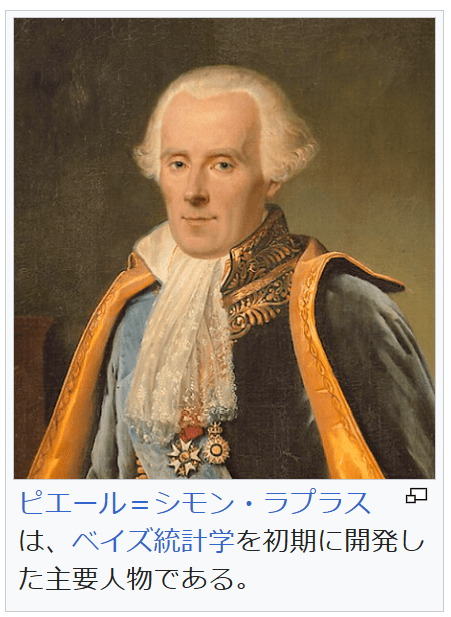
これはラプラスの客観的なアプローチより前のことであった[68]。主観的なベイズ統計学の手法は、1950年代に Leonard Jimmie Savage によってさらに発展し普及した[要出典]。
客観的なベイズ推定はさらにハロルド・ジェフリーズ(ケンブリッジ大学)によって発展した。
彼の独創的な著書『確率論』(Theory of probability)が1939年に最初に登場し、ベイズ確率の再興に重要な役割を果たした[70][71]。
^ Ball, Philip (2004). Critical Mass. Farrar, Straus and Giroux. p. 53. ISBN 978-0-374-53041-9 ^ a b c 酒井弘憲「数式なしの統計のお話 第2回 統計のルーツを探る」『ファルマシア』第50巻第4号、2014年、334–335頁、doi:10.14894/faruawpsj.50.4_334。 ^ a b “意外に面白い!統計学を歴史から眺めてみよう!”. 数学・統計教室の和から株式会社 (2021年9月8日). 2022年11月29日閲覧。 ^ a b c 奥積雅彦. “公文書で初めて統計の用語が登場したのはいつか?” (PDF). 国立国会図書館支部総務省統計図書館. 2022年11月29日閲覧。 ^ Thucydides (1985). History of the Peloponnesian War. New York: Penguin Books, Ltd.. p. 204 ^ Giovanni Villani. Encyclopædia Britannica. Encyclopædia Britannica 2006 Ultimate Referece Suite DVD. Retrieved on 2008-03-04. ^ Brian, Éric; Jaisson, Marie (2007). “Physico-Theology and Mathematics (1710-1794)”. The Descent of Human Sex Ratio at Birth. Springer Science & Business Media. pp. 1-25. ISBN 978-1-4020-6036-6 ^ John Arbuthnot (1710). “An argument for Divine Providence, taken from the constant regularity observed in the births of both sexes”. Philosophical Transactions of the Royal Society of London 27 (325-336): 186-190. doi:10.1098/rstl.1710.0011. ^ a b Conover, W.J. (1999), “Chapter 3.4: The Sign Test”, Practical Nonparametric Statistics (Third ed.), Wiley, pp. 157-176, ISBN 978-0-471-16068-7 ^ Sprent, P. (1989), Applied Nonparametric Statistical Methods (Second ed.), Chapman & Hall, ISBN 978-0-412-44980-2 ^ Stephen Mack Stigler (1986). The History of Statistics: The Measurement of Uncertainty Before 1900. Harvard University Press. pp. 225-226. ISBN 978-0-67440341-3 ^ Bellhouse, P. (2001), “John Arbuthnot”, in Statisticians of the Centuries by C.C. Heyde and E. Seneta, Springer, pp. 39-42, ISBN 978-0-387-95329-8 ^ Hald, Anders (1998), “Chapter 4. Chance or Design: Tests of Significance”, A History of Mathematical Statistics from 1750 to 1930, Wiley, p. 65 ^ Abraham de Moivre (1738) The doctrine of chances. Woodfall ^ P=S Laplace (1774). “Mémoire sur la probabilité des causes par les évènements”. Mémoires de l’Académie Royale des Sciences Présentés par Divers Savants 6: 621-656. ^ Wilson, Edwin Bidwell (1923) “First and second laws of error”, Journal of the American Statistical Association, 18 (143), 841-851 JSTOR 2965467 ^ Havil J (2003) Gamma: Exploring Euler’s Constant. Princeton, NJ: Princeton University Press, p.157 ^ Charles Sanders Peirce (1873) Theory of errors of observations. Report of the Superintendent US Coast Survey, Washington, Government Printing Office. Appendix no. 21: 200-224 ^ P. S. Laplace (1781). “MEMOIRE SUR LES PROBABILITÉS”. Oeuvres completes 9: 227-332. 英語訳PDF ^ ウィキソースのロゴ フランス語版ウィキソースに本記事に関連した原文があります:Page:Laplace_-_Œuvres_complètes,_Gauthier-Villars,_1878,_tome_9.djvu/395 ^ William Gemmell Cochran (1978) “Laplace’s ratio estimators”. pp.3-10. In David H.A., (ed). Contributions to Survey Sampling and Applied Statistics: papers in honor of H. O. Hartley. Academic Press, New York ISBN 978-1483237930 ^ John Maynard Keynes (1921) A treatise on probability. Pt II Ch XVII §5 (p 201) ^ Francis Galton (1881) Report of the Anthropometric Committee pp.245-260. Report of the 51st Meeting of the British Association for the Advancement of Science ^ Stigler (1986, Chapter 5: Quetelet’s Two Attempts) ^ Helen Mary Walker (1975). Studies in the history of statistical method. Arno Press. ISBN 9780405066283 ^ (Stigler 1986, Chapter 9: The Next Generation: Edgeworth) ^ Bellhouse DR (1988) A brief history of random sampling methods. Handbook of statistics. Vol 6 pp.1-14 Elsevier ^ Bowley, AL (1906). “Address to the Economic Science and Statistics Section of the British Association for the Advancement of Science”. J R Stat Soc 69: 548-557. doi:10.2307/2339344. JSTOR 2339344. ^ Francis Galton (1877). “Typical laws of heredity”. Nature 15 (388): 492-553. doi:10.1038/015492a0. ^ Francis Galton (1907). “One Vote, One Value”. Nature 75 (1948): 414. doi:10.1038/075414a0. ^ Stigler (1986, Chapter 10: Pearson and Yule) ^ Varberg, Dale E. (1963). “The development of modern statistics”. The Mathematics Teacher 56 (4): 252-257. JSTOR 27956805. ^ Stephen Mack Stigler (1989). “Francis Galton’s Account of the Invention of Correlation”. Statistical Science 4 (2): 73-79. doi:10.1214/ss/1177012580. ^ a b c Karl Pearson (1900). “On the Criterion that a given System of Deviations from the Probable in the Case of a Correlated System of Variables is such that it can be reasonably supposed to have arisen from Random Sampling”. Philosophical Magazine. Series 5 50 (302): 157-175. doi:10.1080/14786440009463897. ^ Karl Pearson (1901). “On Lines and Planes of Closest Fit to Systems of Points is Space”. Philosophical Magazine. Series 6 2 (11): 559-572. doi:10.1080/14786440109462720. ^ I.T. Jolliffe (2002) Principal Component Analysis, 2nd ed. New York: Springer-Verlag. ^ Box, R.A. Fisher, pp.93-166 ^ Agresti, Alan; David B. Hichcock (2005). “Bayesian Inference for Categorical Data Analysis”. Statistical Methods & Applications 14 (3): 298. doi:10.1007/s10260-005-0121-y. ^ R.A. Fisher (1925) Statistical methods for research workers, Edinburgh: Oliver & Boyd ^ Jerzy Neyman (1934) On the two different aspects of the representative method: The method of stratified sampling and the method of purposive selection. Journal of the Royal Statistical Society 97 (4) 557-625 JSTOR 2342192 ^ Dunn, Peter (1997-01). “James Lind (1716-94) of Edinburgh and the treatment of scurvy”. Archives of Disease in Childhood: Fetal and Neonatal Edition 76 (1): 64-65. doi:10.1136/fn.76.1.F64. PMC 1720613. PMID 9059193. ^ a b Klaus Hinkelmann (2012). Design and Analysis of Experiments, Special Designs and Applications. John Wiley & Sons. p. xvii. ISBN 9780470530689 ^ a b Charles Sanders Peirce, Joseph Jastrow (1885). “On Small Differences in Sensation”. Memoirs of the National Academy of Sciences 3: 73-83. ^ a b Ian Hacking (1988-09). “Telepathy: Origins of Randomization in Experimental Design”. Isis 79 (A Special Issue on Artifact and Experiment, number 3): 427-451. doi:10.1086/354775. JSTOR 234674. MR1013489. ^ a b Stephen Mack Stigler (1992-11). “A Historical View of Statistical Concepts in Psychology and Educational Research”. American Journal of Education 101 (1): 60-70. doi:10.1086/444032. ^ a b Trudy Dehue (1997-12). “Deception, Efficiency, and Random Groups: Psychology and the Gradual Origination of the Random Group Design”. Isis 88 (4): 653-673. doi:10.1086/383850. PMID 9519574. ^ C.S. Peirce (1876). “Note on the Theory of the Economy of Research”. Coast Survey Report: 197-201., actually published 1879, NOAA PDF Eprint. Reprinted in Collected Papers 7, paragraphs 139-157, also in Writings 4, pp.72-78, and in Charles Sanders Peirce (1967年7-8月). “Note on the Theory of the Economy of Research”. Operations Research 15 (4): 643-648. doi:10.1287/opre.15.4.643. JSTOR 168276. ^ Smith, Kirstine (1918). “On the Standard Deviations of Adjusted and Interpolated Values of an Observed Polynomial Function and its Constants and the Guidance they give Towards a Proper Choice of the Distribution of Observations”. Biometrika 12 (1/2): 1-85. doi:10.2307/2331929. JSTOR 2331929. ^ Abraham Wald (1945) “Sequential Tests of Statistical Hypotheses”, Annals of Mathematical Statistics, 16 (2), 117-186. ^ Johnson, N.L. (1961). “Sequential analysis: a survey.” Journal of the Royal Statistical Society, Series A. Vol. 124 (3), 372-411. (pages 375-376) ^ Herman Chernoff (1972) Sequential Analysis and Optimal Design, SIAM Monograph. ISBN 978-0898710069 ^ Zacks, S. (1996) “Adaptive Designs for Parametric Models”. In: Ghosh, S. and Rao, C. R., (Eds) (1996). “Design and Analysis of Experiments,” Handbook of Statistics, Volume 13. North-Holland. ISBN 0-444-82061-2. (pp.151-180) ^ Robbins, H. (1952). “Some Aspects of the Sequential Design of Experiments”. Bulletin of the American Mathematical Society 58 (5): 527-535. doi:10.1090/S0002-9904-1952-09620-8. ^ Hald, Anders (1998) A History of Mathematical Statistics. New York: Wiley. [要ページ番号] ^ Box, Joan Fisher (1978) R. A. Fisher: The Life of a Scientist, Wiley. ISBN 0-471-09300-9 (pp.93-166) ^ Edwards, A.W.F. (2005). “R. A. Fisher, Statistical Methods for Research Workers, 1925”. In Grattan-Guinness, Ivor. Landmark writings in Western mathematics 1640-1940. Amsterdam Boston: Elsevier. ISBN 9780444508713 ^ Stanley, J. C. (1966). “The Influence of Fisher’s “The Design of Experiments” on Educational Research Thirty Years Later”. American Educational Research Journal 3 (3): 223-229. doi:10.3102/00028312003003223. ^ Box, JF (1980-02). “R. A. Fisher and the Design of Experiments, 1922-1926”. The American Statistician 34 (1): 1-7. doi:10.2307/2682986. JSTOR 2682986. ^ Frank Yates (1964-06). “Sir Ronald Fisher and the Design of Experiments”. Biometrics 20 (2): 307-321. doi:10.2307/2528399. JSTOR 2528399. ^ Stanley, Julian C. (1966). “The Influence of Fisher’s “The Design of Experiments” on Educational Research Thirty Years Later”. American Educational Research Journal 3 (3): 223-229. doi:10.3102/00028312003003223. JSTOR 1161806. ^ a b c Stigler (1986, Chapter 3: Inverse Probability) ^ Hald (1998)[要ページ番号] ^ Lucien Le Cam (1986) Asymptotic Methods in Statistical Decision Theory: pp.336, 618-621(von Mises と Bernstein). ^ a b c Stephen. E. Fienberg, (2006) When did Bayesian Inference become “Bayesian”? Archived 2014-09-10 at the Wayback Machine. Bayesian Analysis, 1 (1), 1-40. See page 5. ^ a b Aldrich, A (2008). “R. A. Fisher on Bayes and Bayes’ Theorem”. Bayesian Analysis 3 (1): 161-170. doi:10.1214/08-ba306. ^ Jerzy Neyman (1977). “Frequentist probability and frequentist statistics”. Synthese 36 (1): 97-131. doi:10.1007/BF00485695. ^ Jeff Miller, “Earliest Known Uses of Some of the Words of Mathematics (B)” “The term Bayesian entered circulation around 1950. R. A. Fisher used it in the notes he wrote to accompany the papers in his Contributions to Mathematical Statistics (1950). Fisher thought Bayes’s argument was all but extinct for the only recent work to take it seriously was Harold Jeffreys’s Theory of Probability (1939). In 1951 L. J. Savage, reviewing Wald’s Statistical Decisions Functions, referred to “modern, or unBayesian, statistical theory” (“The Theory of Statistical Decision,” Journal of the American Statistical Association, 46, p.58.). Soon after, however, Savage changed from being an unBayesian to being a Bayesian.” ^ a b c José-Miguel Bernardo (2005). “Reference analysis”. Bayesian Thinking – Modeling and Computation. Handbook of Statistics. 25. pp. 17-90. doi:10.1016/S0169-7161(05)25002-2. ISBN 9780444515391 ^ Donald A. Gillies (2000), Philosophical Theories of Probability. Routledge. ISBN 0-415-18276-X pp.50-1 ^ E.T. Jaynes Probability Theory: The Logic of Science Cambridge University Press, (2003). ISBN 0-521-59271-2 ^ O’Connor, John J.; Robertson, Edmund F., “統計学の歴史”, MacTutor History of Mathematics archive, University of St Andrews. ^ J.M. Bernardo, A.F.M. Smith (1994). “Bayesian Theory”. Chichester: Wiley. ^ Wolpert, RL (2004). “A conversation with James O. Berger”. Statistical Science 9: 205-218. doi:10.1214/088342304000000053. MR2082155. ^ Bernardo, J.M. (2006). “A Bayesian Mathematical Statistics Primer” (PDF). Proceedings of the Seventh International Conference on Teaching Statistics [CDROM]. Salvador (Bahia), Brazil: International Association for Statistical Education. ^ C.M. Bishop (2007) Pattern Recognition and Machine Learning. Springer ISBN 978-0387310732 ^ 統計学の歴史〜古代ローマから現代まで〜 | AVILEN AI Trend 2020年4月14日、2022年6月26日閲覧。 参考文献 Freedman, D. (1999). “From association to causation: Some remarks on the history of statistics”. Statistical Science 14 (3): 243-258. doi:10.1214/ss/1009212409. (Revised version, 2002) Anders Hald (2003). A History of Probability and Statistics and Their Applications before 1750. Hoboken, NJ: Wiley. ISBN 978-0-471-47129-5 Anders Hald (1998). A History of Mathematical Statistics from 1750 to 1930. New York: Wiley. ISBN 978-0-471-17912-2 Kotz, S., Johnson, N.L. (1992,1992,1997). Breakthroughs in Statistics, Vols I, II, III. Springer ISBN 0-387-94037-5, 0-387-94039-1, 0-387-94989-5 エゴン・ピアソン (1978). The History of Statistics in the 17th and 18th Centuries against the changing background of intellectual, scientific and religious thought(カール・ピアソンによる、ユニヴァーシティ・カレッジ・ロンドンの 1921-1933 の academic session での講義). New York: MacMillan Publishing Co., Inc.. p. 744. ISBN 978-0-02-850120-8 David Salsburg (2001). The Lady Tasting Tea: How Statistics Revolutionized Science in the Twentieth Century. ISBN 0-7167-4106-7 スティーブン・スティグラー (1986). The History of Statistics: The Measurement of Uncertainty before 1900. Belknap Press/Harvard University Press. ISBN 978-0-674-40341-3 スティーブン・スティグラー (1999) Statistics on the Table: The History of Statistical Concepts and Methods. ハーバード大学出版局。ISBN 0-674-83601-4 David, H.A. (1995). “First (?) Occurrence of Common Terms in Mathematical Statistics”. The American Statistician 49 (2): 121-133. doi:10.2307/2684625. JSTOR 2684625. 外部リンク
ウィキメディア・コモンズには、統計学の歴史に関連するカテゴリがあります。 JEHPS: Recent publications in the history of probability and statistics Electronic Journ@l for History of Probability and Statistics/Journ@l Electronique d’Histoire des Probabilités et de la Statistique Figures from the History of Probability and Statistics – サウサンプトン大学(イギリスの旗 イギリス) Materials for the History of Statistics – ヨーク大学(イギリスの旗 イギリス) Probability and Statistics on the Earliest Uses Pages – サウサンプトン大学(イギリスの旗 イギリス) Earliest Uses of Symbols in Probability and Statistics – Earliest Uses of Various Mathematical Symbols 表話編歴 統計学 カテゴリ: 科学史確率と統計分野別の科学史 最終更新 2024年10月19日 (土) 16:11 (日時は個人設定で未設定ならばUTC)。 テキストはクリエイティブ・コモンズ 表示-継承ライセンスのもとで利用できます。追加の条件が適用される場合があります。詳細については利用規約を参照してください。』



















 ジジイがあれこれ考えた