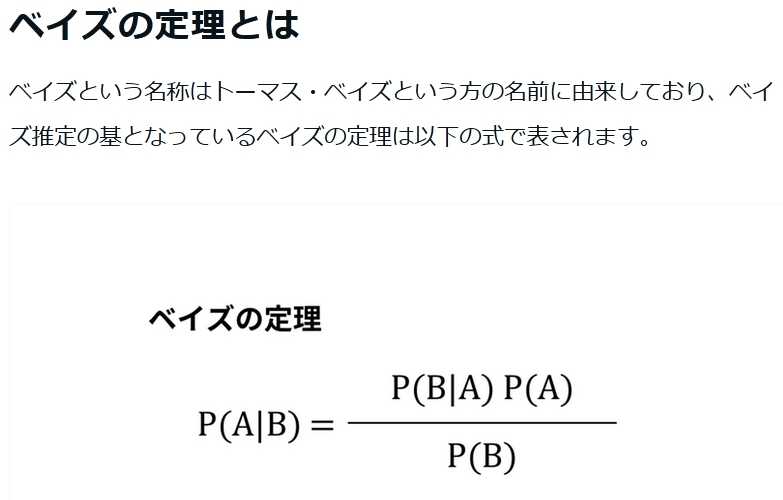
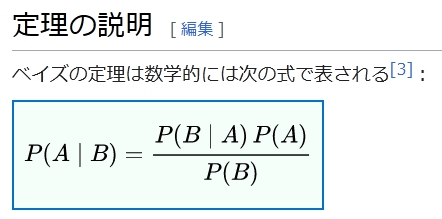
P ( A ∣ B ) = P ( B ∣ A ) P ( A ) P ( B ) {\displaystyle P(A\mid B)={\frac {P(B\mid A)\,P(A)}{P(B)}}}
ここで、 A {\displaystyle A} そして B {\displaystyle B} は事象であり、 P ( B ) ≠ 0 {\displaystyle P(B)\neq 0} である。
P ( A ∣ B ) {\displaystyle P(A\mid B)} は条件付き確率であり、 B {\displaystyle B} が真であるとき事象 A {\displaystyle A} が発生する確率である。
B {\displaystyle B} が与えられたときの A {\displaystyle A} の事後確率ともいう。 P ( B ∣ A ) {\displaystyle P(B\mid A)} もまた条件付き確率でもあり、 A {\displaystyle A} が 真である場合に B {\displaystyle B} が発生する確率である。
また、 P ( B ∣ A ) = L ( A ∣ B ) {\displaystyle P(B\mid A)=L(A\mid B)} であることから、固定された B {\displaystyle B} に対する A {\displaystyle A} の尤度とも解釈できる。
P ( A ) {\displaystyle P(A)} と P ( B ) {\displaystyle P(B)} は、与えられた条件なしに A {\displaystyle A} と B {\displaystyle B} がそれぞれ観測される確率で、周辺確率や事前確率と呼ばれている。

A {\displaystyle A}そして B {\displaystyle B}は別の事象である必要がある。
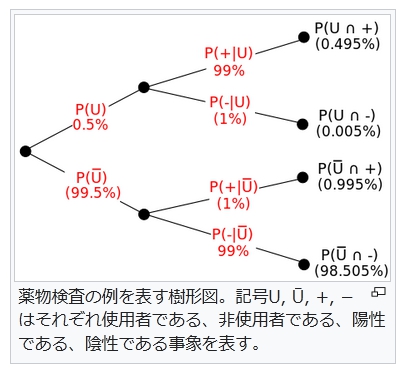
P ( U ∣ + ) = P ( + ∣ U ) P ( U ) P ( + ) = P ( + ∣ U ) P ( U ) P ( + ∣ U ) P ( U ) + P ( + ∣ U ¯ ) P ( U ¯ ) = 0.99 × 0.005 0.99 × 0.005 + 0.01 × 0.995 ≈ 0.332 {\displaystyle {\begin{aligned}P({\text{U}}\mid {\text{+}})&={\frac {P({\text{+}}\mid {\text{U}})\,P({\text{U}})}{P(+)}}\\&={\frac {P({\text{+}}\mid {\text{U}})\,P({\text{U}})}{P({\text{+}}\mid {\text{U}})\,P({\text{U}})+P({\text{+}}\mid {\overline {\text{U}}})\,P({\overline {\text{U}}})}}\\&={\frac {0.99\times 0.005}{0.99\times 0.005+0.01\times 0.995}}\\&\approx 0.332\end{aligned}}}
個人の検査が陽性であるときでさえ、非使用者である可能性が使用者である可能性よりも高い。
(それでも検査結果が陽性であったという情報を反映して、事後確率 P ( U ∣ + ) ≈ 0.332 {\displaystyle P({\text{U}}\mid {\text{+}})\approx 0.332} は事前確率 P ( U ) = 0.005 {\displaystyle P({\text{U}})=0.005} よりも大幅に上昇している。)
^ Frame, Paul (2015). Liberty's Apostle. Wales: University of Wales Press. ISBN 978-1-78316-216-1 2021年2月23日閲覧。
^ Joyce, James (2003), Zalta, Edward N., ed., “Bayes' Theorem”, The Stanford Encyclopedia of Philosophy (Metaphysics Research Lab, Stanford University) 2020年1月17日閲覧。
^ Stuart, A.; Ord, K. (1994), Kendall's Advanced Theory of Statistics: Volume I—Distribution Theory, Edward Arnold, §8.7
参考文献
Bayes, Thomas; Price, Richard (1763). “An Essay towards solving a Problem in the Doctrine of Chance. By the late Rev. Mr. Bayes, communicated by Mr. Price, in a letter to John Canton, M. A. and F. R. S.” (PDF). Philosophical Transactions of the Royal Society of London (Royal Society) 53 (0): 370–418. doi:10.1098/rstl.1763.0053.
Gelman, Andrew; Carlin, John B.; Stern, Hal S.; Dunson, David B.; Vehtari, Aki; Rubin, Donald B. (2014). Bayesian Data Analysis. Texts in Statistical Science Series (Third ed.). CRC Press. ISBN 978-1-4398-4095-5. MR3235677. Zbl 1279.62004
Stigler, Stephen M. (1986). The History of Statistics. The Belknap Press of Harvard University Press. ISBN 0-674-40340-1. MR0852410. Zbl 0656.62005
P は確率(Probability)の頭文字で、P(M|D)は「飛行機がひどく揺れていると仮定した場合の墜落の確率」。それを計算するには「なにも起きていない段階で、飛行機が墜落する統計的確率(1000万分の1)」「墜落する前にひどい揺れが起きる確 率(これは間違いないので確率1=100%)」「無事に着陸できるのにひどく揺れる確率(このような統計はすぐに手に入らないので、主観的に100分の1とする)」があればいい。これをベイズの数式にあてはめると、この飛行機が墜落する確率が10万分の1で、無事に着陸できる確率が99.999%であることがわかる(1)。









 ジジイがあれこれ考えた