超人的な仕事ぶりと必要であれば相手が誰であろうと直言を厭わない果敢な姿勢により、交渉相手となる陸軍・政府関係者はナイチンゲールに敬意を示し、また恐れもした。ロンドン市内メイフェアのオールド・バーリントン通り (en) のバーリントン・ホテル内にあったナイチンゲールの住居兼事務所は関係者の間で敬意と揶揄の双方の意味を込めて「小戦争省(Little war office)」とあだ名された。
ナイチンゲール誓詞(Nightingale Pledge)は、1893年アメリカ合衆国ミシガン州デトロイト市にあるハーパー病院(Harper Hospital)のファーランド看護学校 (Farrand Training School for Nurses) の校長リストラ・グレッター(英語版)夫人を委員長とする委員会で、ナイチンゲールの偉業を讃え作成されたものである。
ナイチンゲール病棟 →「ナイチンゲール病棟」も参照
ナイチンゲールが考案した病院建築。『病院覚え書』(Notes on Hospitals)に図面入りで記されている。
グスタフ・フェヒナーは社会学的および心理学的現象で中央値 (Centralwerth) を用いた[22]。それ以前では天文学とその関連分野でしか使われていなかった。フランシス・ゴルトンは1881年に、初めて英語での用語として median を用いた。それより以前では、1869年に middle-most value が、1880年には medium が使用されていた[23]。
オックスフォード大学の学者であるフランシス・イシドロ・エッジワースは著書 “Metretike: or The Method of Measuring Probability and Utility” (1887) で、帰納的推論の基礎として確率を扱っており、彼の後の作品では「偶然の哲学」に焦点が当てられていた[26]。
彼の統計学に関する最初の論文 (1883) は誤差の法則(正規分布)を調べたものであった。
そして彼の “Methods of Statistics” (1885) では、t分布の初期のバージョン、エッジワース展開、エッジワース級数(英語版)、変数変換する方法、最尤推定の漸近理論が導入された。
社会情勢の統計調査は、チャールス・ブースの “Life and Labour of the People in London” (1889-1903)、シーボーム・ラウントリーの “Poverty, A Study of Town Life” (1901) に端を発したが、中でも革新的なのは、ボウリーの無作為抽出による手法である。彼の功績は “New Survey of London Life and Labour” で最高潮に達した[28]。
フィッシャーの論文 “On a distribution yielding the error functions of several well known statistics”(よく知られた統計集団の誤差関数を与える分布について、1924年)には、ピアソンのカイ二乗検定、正規分布と同じ構成での、ウィリアム・ゴセットのt分布、分散分析における、フィッシャーのz分布(英語版)(数十年後に、より一般化したF分布の形で用いられるようになる)の変数が示されている[38]。
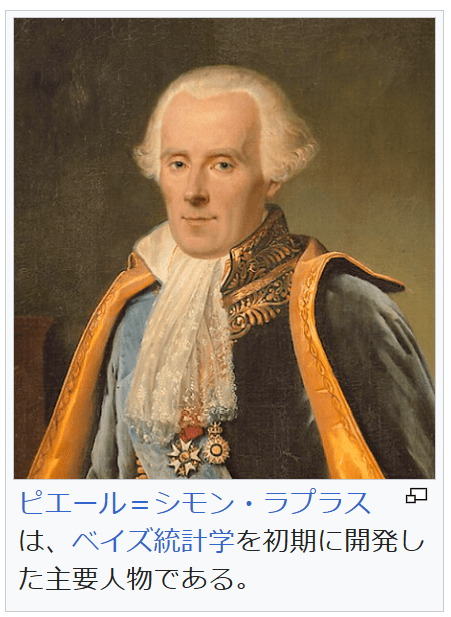
この発想はさらに、ブルーノ・デ・フィネッティ(イタリア、Fondamenti Logici del Ragionamento Probabilistico, 1930)、フランク・ラムゼイ(ケンブリッジ、The Foundations of Mathematics, 1931)に取り入れられた[69]。
このアプローチは、統計的確率についての問題点を解決するために考案された。
これはラプラスの客観的なアプローチより前のことであった[68]。主観的なベイズ統計学の手法は、1950年代に Leonard Jimmie Savage によってさらに発展し普及した[要出典]。
客観的なベイズ推定はさらにハロルド・ジェフリーズ(ケンブリッジ大学)によって発展した。
彼の独創的な著書『確率論』(Theory of probability)が1939年に最初に登場し、ベイズ確率の再興に重要な役割を果たした[70][71]。
^ Ball, Philip (2004). Critical Mass. Farrar, Straus and Giroux. p. 53. ISBN 978-0-374-53041-9 ^ a b c 酒井弘憲「数式なしの統計のお話 第2回 統計のルーツを探る」『ファルマシア』第50巻第4号、2014年、334–335頁、doi:10.14894/faruawpsj.50.4_334。 ^ a b “意外に面白い!統計学を歴史から眺めてみよう!”. 数学・統計教室の和から株式会社 (2021年9月8日). 2022年11月29日閲覧。 ^ a b c 奥積雅彦. “公文書で初めて統計の用語が登場したのはいつか?” (PDF). 国立国会図書館支部総務省統計図書館. 2022年11月29日閲覧。 ^ Thucydides (1985). History of the Peloponnesian War. New York: Penguin Books, Ltd.. p. 204 ^ Giovanni Villani. Encyclopædia Britannica. Encyclopædia Britannica 2006 Ultimate Referece Suite DVD. Retrieved on 2008-03-04. ^ Brian, Éric; Jaisson, Marie (2007). “Physico-Theology and Mathematics (1710-1794)”. The Descent of Human Sex Ratio at Birth. Springer Science & Business Media. pp. 1-25. ISBN 978-1-4020-6036-6 ^ John Arbuthnot (1710). “An argument for Divine Providence, taken from the constant regularity observed in the births of both sexes”. Philosophical Transactions of the Royal Society of London 27 (325-336): 186-190. doi:10.1098/rstl.1710.0011. ^ a b Conover, W.J. (1999), “Chapter 3.4: The Sign Test”, Practical Nonparametric Statistics (Third ed.), Wiley, pp. 157-176, ISBN 978-0-471-16068-7 ^ Sprent, P. (1989), Applied Nonparametric Statistical Methods (Second ed.), Chapman & Hall, ISBN 978-0-412-44980-2 ^ Stephen Mack Stigler (1986). The History of Statistics: The Measurement of Uncertainty Before 1900. Harvard University Press. pp. 225-226. ISBN 978-0-67440341-3 ^ Bellhouse, P. (2001), “John Arbuthnot”, in Statisticians of the Centuries by C.C. Heyde and E. Seneta, Springer, pp. 39-42, ISBN 978-0-387-95329-8 ^ Hald, Anders (1998), “Chapter 4. Chance or Design: Tests of Significance”, A History of Mathematical Statistics from 1750 to 1930, Wiley, p. 65 ^ Abraham de Moivre (1738) The doctrine of chances. Woodfall ^ P=S Laplace (1774). “Mémoire sur la probabilité des causes par les évènements”. Mémoires de l’Académie Royale des Sciences Présentés par Divers Savants 6: 621-656. ^ Wilson, Edwin Bidwell (1923) “First and second laws of error”, Journal of the American Statistical Association, 18 (143), 841-851 JSTOR 2965467 ^ Havil J (2003) Gamma: Exploring Euler’s Constant. Princeton, NJ: Princeton University Press, p.157 ^ Charles Sanders Peirce (1873) Theory of errors of observations. Report of the Superintendent US Coast Survey, Washington, Government Printing Office. Appendix no. 21: 200-224 ^ P. S. Laplace (1781). “MEMOIRE SUR LES PROBABILITÉS”. Oeuvres completes 9: 227-332. 英語訳PDF ^ ウィキソースのロゴ フランス語版ウィキソースに本記事に関連した原文があります:Page:Laplace_-_Œuvres_complètes,_Gauthier-Villars,_1878,_tome_9.djvu/395 ^ William Gemmell Cochran (1978) “Laplace’s ratio estimators”. pp.3-10. In David H.A., (ed). Contributions to Survey Sampling and Applied Statistics: papers in honor of H. O. Hartley. Academic Press, New York ISBN 978-1483237930 ^ John Maynard Keynes (1921) A treatise on probability. Pt II Ch XVII §5 (p 201) ^ Francis Galton (1881) Report of the Anthropometric Committee pp.245-260. Report of the 51st Meeting of the British Association for the Advancement of Science ^ Stigler (1986, Chapter 5: Quetelet’s Two Attempts) ^ Helen Mary Walker (1975). Studies in the history of statistical method. Arno Press. ISBN 9780405066283 ^ (Stigler 1986, Chapter 9: The Next Generation: Edgeworth) ^ Bellhouse DR (1988) A brief history of random sampling methods. Handbook of statistics. Vol 6 pp.1-14 Elsevier ^ Bowley, AL (1906). “Address to the Economic Science and Statistics Section of the British Association for the Advancement of Science”. J R Stat Soc 69: 548-557. doi:10.2307/2339344. JSTOR 2339344. ^ Francis Galton (1877). “Typical laws of heredity”. Nature 15 (388): 492-553. doi:10.1038/015492a0. ^ Francis Galton (1907). “One Vote, One Value”. Nature 75 (1948): 414. doi:10.1038/075414a0. ^ Stigler (1986, Chapter 10: Pearson and Yule) ^ Varberg, Dale E. (1963). “The development of modern statistics”. The Mathematics Teacher 56 (4): 252-257. JSTOR 27956805. ^ Stephen Mack Stigler (1989). “Francis Galton’s Account of the Invention of Correlation”. Statistical Science 4 (2): 73-79. doi:10.1214/ss/1177012580. ^ a b c Karl Pearson (1900). “On the Criterion that a given System of Deviations from the Probable in the Case of a Correlated System of Variables is such that it can be reasonably supposed to have arisen from Random Sampling”. Philosophical Magazine. Series 5 50 (302): 157-175. doi:10.1080/14786440009463897. ^ Karl Pearson (1901). “On Lines and Planes of Closest Fit to Systems of Points is Space”. Philosophical Magazine. Series 6 2 (11): 559-572. doi:10.1080/14786440109462720. ^ I.T. Jolliffe (2002) Principal Component Analysis, 2nd ed. New York: Springer-Verlag. ^ Box, R.A. Fisher, pp.93-166 ^ Agresti, Alan; David B. Hichcock (2005). “Bayesian Inference for Categorical Data Analysis”. Statistical Methods & Applications 14 (3): 298. doi:10.1007/s10260-005-0121-y. ^ R.A. Fisher (1925) Statistical methods for research workers, Edinburgh: Oliver & Boyd ^ Jerzy Neyman (1934) On the two different aspects of the representative method: The method of stratified sampling and the method of purposive selection. Journal of the Royal Statistical Society 97 (4) 557-625 JSTOR 2342192 ^ Dunn, Peter (1997-01). “James Lind (1716-94) of Edinburgh and the treatment of scurvy”. Archives of Disease in Childhood: Fetal and Neonatal Edition 76 (1): 64-65. doi:10.1136/fn.76.1.F64. PMC 1720613. PMID 9059193. ^ a b Klaus Hinkelmann (2012). Design and Analysis of Experiments, Special Designs and Applications. John Wiley & Sons. p. xvii. ISBN 9780470530689 ^ a b Charles Sanders Peirce, Joseph Jastrow (1885). “On Small Differences in Sensation”. Memoirs of the National Academy of Sciences 3: 73-83. ^ a b Ian Hacking (1988-09). “Telepathy: Origins of Randomization in Experimental Design”. Isis 79 (A Special Issue on Artifact and Experiment, number 3): 427-451. doi:10.1086/354775. JSTOR 234674. MR1013489. ^ a b Stephen Mack Stigler (1992-11). “A Historical View of Statistical Concepts in Psychology and Educational Research”. American Journal of Education 101 (1): 60-70. doi:10.1086/444032. ^ a b Trudy Dehue (1997-12). “Deception, Efficiency, and Random Groups: Psychology and the Gradual Origination of the Random Group Design”. Isis 88 (4): 653-673. doi:10.1086/383850. PMID 9519574. ^ C.S. Peirce (1876). “Note on the Theory of the Economy of Research”. Coast Survey Report: 197-201., actually published 1879, NOAA PDF Eprint. Reprinted in Collected Papers 7, paragraphs 139-157, also in Writings 4, pp.72-78, and in Charles Sanders Peirce (1967年7-8月). “Note on the Theory of the Economy of Research”. Operations Research 15 (4): 643-648. doi:10.1287/opre.15.4.643. JSTOR 168276. ^ Smith, Kirstine (1918). “On the Standard Deviations of Adjusted and Interpolated Values of an Observed Polynomial Function and its Constants and the Guidance they give Towards a Proper Choice of the Distribution of Observations”. Biometrika 12 (1/2): 1-85. doi:10.2307/2331929. JSTOR 2331929. ^ Abraham Wald (1945) “Sequential Tests of Statistical Hypotheses”, Annals of Mathematical Statistics, 16 (2), 117-186. ^ Johnson, N.L. (1961). “Sequential analysis: a survey.” Journal of the Royal Statistical Society, Series A. Vol. 124 (3), 372-411. (pages 375-376) ^ Herman Chernoff (1972) Sequential Analysis and Optimal Design, SIAM Monograph. ISBN 978-0898710069 ^ Zacks, S. (1996) “Adaptive Designs for Parametric Models”. In: Ghosh, S. and Rao, C. R., (Eds) (1996). “Design and Analysis of Experiments,” Handbook of Statistics, Volume 13. North-Holland. ISBN 0-444-82061-2. (pp.151-180) ^ Robbins, H. (1952). “Some Aspects of the Sequential Design of Experiments”. Bulletin of the American Mathematical Society 58 (5): 527-535. doi:10.1090/S0002-9904-1952-09620-8. ^ Hald, Anders (1998) A History of Mathematical Statistics. New York: Wiley. [要ページ番号] ^ Box, Joan Fisher (1978) R. A. Fisher: The Life of a Scientist, Wiley. ISBN 0-471-09300-9 (pp.93-166) ^ Edwards, A.W.F. (2005). “R. A. Fisher, Statistical Methods for Research Workers, 1925”. In Grattan-Guinness, Ivor. Landmark writings in Western mathematics 1640-1940. Amsterdam Boston: Elsevier. ISBN 9780444508713 ^ Stanley, J. C. (1966). “The Influence of Fisher’s “The Design of Experiments” on Educational Research Thirty Years Later”. American Educational Research Journal 3 (3): 223-229. doi:10.3102/00028312003003223. ^ Box, JF (1980-02). “R. A. Fisher and the Design of Experiments, 1922-1926”. The American Statistician 34 (1): 1-7. doi:10.2307/2682986. JSTOR 2682986. ^ Frank Yates (1964-06). “Sir Ronald Fisher and the Design of Experiments”. Biometrics 20 (2): 307-321. doi:10.2307/2528399. JSTOR 2528399. ^ Stanley, Julian C. (1966). “The Influence of Fisher’s “The Design of Experiments” on Educational Research Thirty Years Later”. American Educational Research Journal 3 (3): 223-229. doi:10.3102/00028312003003223. JSTOR 1161806. ^ a b c Stigler (1986, Chapter 3: Inverse Probability) ^ Hald (1998)[要ページ番号] ^ Lucien Le Cam (1986) Asymptotic Methods in Statistical Decision Theory: pp.336, 618-621(von Mises と Bernstein). ^ a b c Stephen. E. Fienberg, (2006) When did Bayesian Inference become “Bayesian”? Archived 2014-09-10 at the Wayback Machine. Bayesian Analysis, 1 (1), 1-40. See page 5. ^ a b Aldrich, A (2008). “R. A. Fisher on Bayes and Bayes’ Theorem”. Bayesian Analysis 3 (1): 161-170. doi:10.1214/08-ba306. ^ Jerzy Neyman (1977). “Frequentist probability and frequentist statistics”. Synthese 36 (1): 97-131. doi:10.1007/BF00485695. ^ Jeff Miller, “Earliest Known Uses of Some of the Words of Mathematics (B)” “The term Bayesian entered circulation around 1950. R. A. Fisher used it in the notes he wrote to accompany the papers in his Contributions to Mathematical Statistics (1950). Fisher thought Bayes’s argument was all but extinct for the only recent work to take it seriously was Harold Jeffreys’s Theory of Probability (1939). In 1951 L. J. Savage, reviewing Wald’s Statistical Decisions Functions, referred to “modern, or unBayesian, statistical theory” (“The Theory of Statistical Decision,” Journal of the American Statistical Association, 46, p.58.). Soon after, however, Savage changed from being an unBayesian to being a Bayesian.” ^ a b c José-Miguel Bernardo (2005). “Reference analysis”. Bayesian Thinking – Modeling and Computation. Handbook of Statistics. 25. pp. 17-90. doi:10.1016/S0169-7161(05)25002-2. ISBN 9780444515391 ^ Donald A. Gillies (2000), Philosophical Theories of Probability. Routledge. ISBN 0-415-18276-X pp.50-1 ^ E.T. Jaynes Probability Theory: The Logic of Science Cambridge University Press, (2003). ISBN 0-521-59271-2 ^ O’Connor, John J.; Robertson, Edmund F., “統計学の歴史”, MacTutor History of Mathematics archive, University of St Andrews. ^ J.M. Bernardo, A.F.M. Smith (1994). “Bayesian Theory”. Chichester: Wiley. ^ Wolpert, RL (2004). “A conversation with James O. Berger”. Statistical Science 9: 205-218. doi:10.1214/088342304000000053. MR2082155. ^ Bernardo, J.M. (2006). “A Bayesian Mathematical Statistics Primer” (PDF). Proceedings of the Seventh International Conference on Teaching Statistics [CDROM]. Salvador (Bahia), Brazil: International Association for Statistical Education. ^ C.M. Bishop (2007) Pattern Recognition and Machine Learning. Springer ISBN 978-0387310732 ^ 統計学の歴史〜古代ローマから現代まで〜 | AVILEN AI Trend 2020年4月14日、2022年6月26日閲覧。 参考文献 Freedman, D. (1999). “From association to causation: Some remarks on the history of statistics”. Statistical Science 14 (3): 243-258. doi:10.1214/ss/1009212409. (Revised version, 2002) Anders Hald (2003). A History of Probability and Statistics and Their Applications before 1750. Hoboken, NJ: Wiley. ISBN 978-0-471-47129-5 Anders Hald (1998). A History of Mathematical Statistics from 1750 to 1930. New York: Wiley. ISBN 978-0-471-17912-2 Kotz, S., Johnson, N.L. (1992,1992,1997). Breakthroughs in Statistics, Vols I, II, III. Springer ISBN 0-387-94037-5, 0-387-94039-1, 0-387-94989-5 エゴン・ピアソン (1978). The History of Statistics in the 17th and 18th Centuries against the changing background of intellectual, scientific and religious thought(カール・ピアソンによる、ユニヴァーシティ・カレッジ・ロンドンの 1921-1933 の academic session での講義). New York: MacMillan Publishing Co., Inc.. p. 744. ISBN 978-0-02-850120-8 David Salsburg (2001). The Lady Tasting Tea: How Statistics Revolutionized Science in the Twentieth Century. ISBN 0-7167-4106-7 スティーブン・スティグラー (1986). The History of Statistics: The Measurement of Uncertainty before 1900. Belknap Press/Harvard University Press. ISBN 978-0-674-40341-3 スティーブン・スティグラー (1999) Statistics on the Table: The History of Statistical Concepts and Methods. ハーバード大学出版局。ISBN 0-674-83601-4 David, H.A. (1995). “First (?) Occurrence of Common Terms in Mathematical Statistics”. The American Statistician 49 (2): 121-133. doi:10.2307/2684625. JSTOR 2684625. 外部リンク
ウィキメディア・コモンズには、統計学の歴史に関連するカテゴリがあります。 JEHPS: Recent publications in the history of probability and statistics Electronic Journ@l for History of Probability and Statistics/Journ@l Electronique d’Histoire des Probabilités et de la Statistique Figures from the History of Probability and Statistics – サウサンプトン大学(イギリスの旗 イギリス) Materials for the History of Statistics – ヨーク大学(イギリスの旗 イギリス) Probability and Statistics on the Earliest Uses Pages – サウサンプトン大学(イギリスの旗 イギリス) Earliest Uses of Symbols in Probability and Statistics – Earliest Uses of Various Mathematical Symbols 表話編歴 統計学 カテゴリ: 科学史確率と統計分野別の科学史 最終更新 2024年10月19日 (土) 16:11 (日時は個人設定で未設定ならばUTC)。 テキストはクリエイティブ・コモンズ 表示-継承ライセンスのもとで利用できます。追加の条件が適用される場合があります。詳細については利用規約を参照してください。』
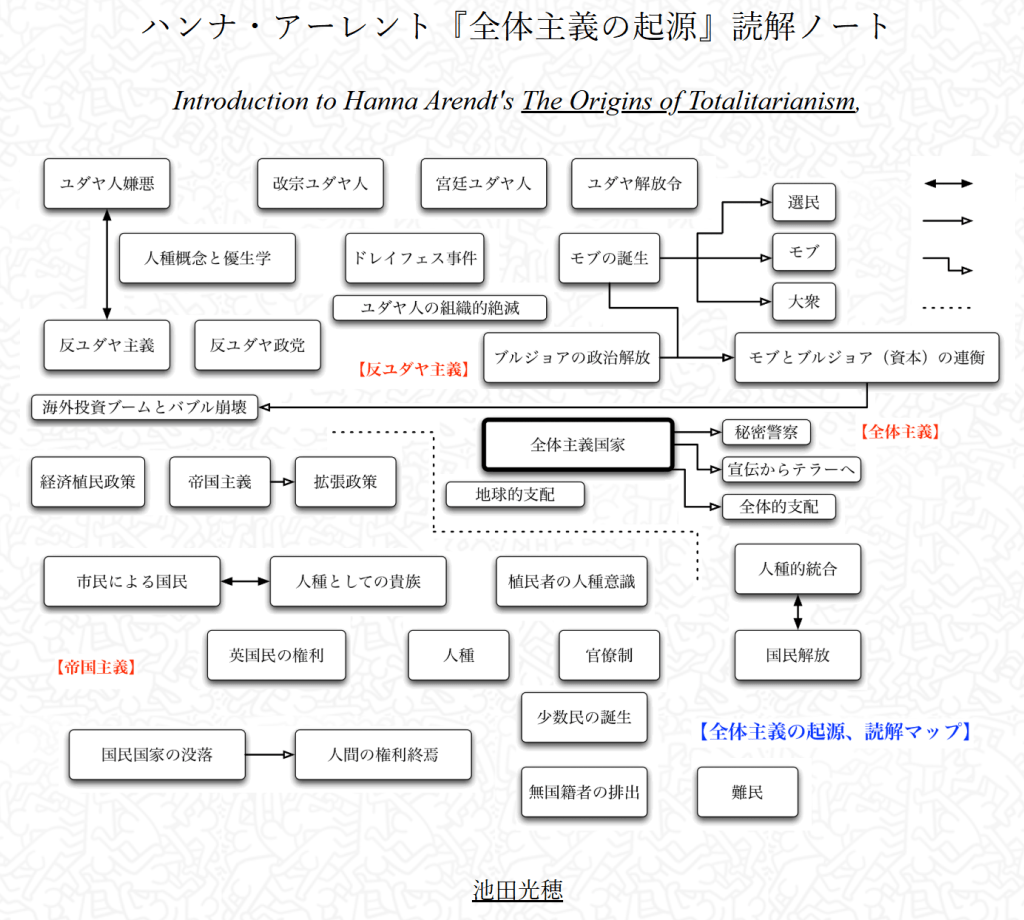
The Origins of Totalitarianism, published in 1951, was Hannah Arendt’s first major work, wherein she describes and analyzes Nazism and Stalinism as the major totalitarian political movements of the first half of the 20th century. 1951年に出版された『全体主義の起源』 は、ハンナ・アーレントの最初の主要著作であり、20世紀前半の主要な全体主義的政治運動としてナチズムとスターリニズムを記述し分析したものである。 The Origins of Totalitarianism (Die Ursprünge des Totalitarismus), 1951 veröffentlicht, war Hannah Arendts erstes großes Werk, in dem sie den Nationalsozialismus und den Stalinismus als die wichtigsten totalitären politischen Bewegungen der ersten Hälfte des 20. Jahrhunderts beschreibt und analysiert. The Origins of Totalitarianism[1] was first published in English in 1951.[1] A German translation was published in 1955 as Elemente und Ursprünge totaler Herrschaft (“Elements and Origins of Totalitarian Rule”). A second, enlarged edition was published in 1958, and contained two additional chapters, replacing her original “Concluding Remarks”.[2] Chapter Thirteen was titled “Ideology and Terror: A novel form of government”, which she had published separately in 1953.[3] Chapter Fourteen dealt with the Hungarian Revolution of 1956, entitled “Epilogue: Reflections on the Hungarian Revolution”. Subsequent editions omitted this chapter, which was published separately in English (“Totalitarian Imperialism: Reflections on the Hungarian Revolution”)[4] and German (Die ungarische Revolution und der totalitäre Imperialismus)[5] in 1958.[6] 1955年に『全体主義の起源』(Elemente und Ursprünge totaler Herrschaft)としてドイツ語訳が出版された[1]。1958年に出版された増補版では、当初の「結びの言葉」に代わって2つの章が追加された [2]。 13章は「イデオロギーと恐怖」と題された。第14章は、1956年のハンガリー革命を扱ったもので、「エピローグ」と題されている[3]。ハンガリー革 命を振り返って」と題されている。その後の版ではこの章が省略され、1958年に英語版(”Totalitarian Imperialism: Reflections on the Hungarian Revolution”)[4]とドイツ語版(Die ungarische Revolution und der totalitäre Imperialismus)[5]で別々に出版されている[6]。 The Origins of Totalitarianism[1] wurde erstmals 1951 in englischer Sprache veröffentlicht. 1955 erschien eine deutsche Übersetzung unter dem Titel Elemente und Ursprünge totaler Herrschaft”. Eine zweite, erweiterte Auflage wurde 1958 veröffentlicht und enthielt zwei zusätzliche Kapitel, die ihre ursprünglichen “Abschließenden Bemerkungen” ersetzten.[2] Kapitel dreizehn trug den Titel “Ideologie und Terror: Eine neue Regierungsform”, das sie 1953 separat veröffentlicht hatte.[3] Kapitel vierzehn befasste sich mit der ungarischen Revolution von 1956 und trug den Titel “Epilog: Reflexionen über die ungarische Revolution”. Spätere Auflagen ließen dieses Kapitel weg, das 1958 separat auf Englisch (“Totalitarian Imperialism: Reflections on the Hungarian Revolution”)[4] und Deutsch (Die ungarische Revolution und der totalitäre Imperialismus)[5] veröffentlicht wurde.[6] Like many of Arendt’s books, The Origins of Totalitarianism is structured as three essays: “Antisemitism”, “Imperialism” and “Totalitarianism”. The book describes the various preconditions and subsequent rise of anti-Semitism in central, eastern, and western Europe in the early-to-mid 19th century; then examines the New Imperialism, from 1884 to the start of the First World War (1914–18); then traces the emergence of racism as an ideology, and its modern application as an “ideological weapon for imperialism”, by the Boers during the Great Trek in the early 19th century (1830s–40s). In this book, Arendt argues that totalitarianism was a “novel form of government,” that “differs essentially from other forms of political oppression known to us such as despotism, tyranny and dictatorship”[7] in that it applied terror to subjugate mass populations rather than just political adversaries.[8][9] Further, Arendt states that, owing to its peculiar ideology and the role assigned to it in its apparatus of coercion, “totalitarianism has discovered a means of dominating and terrorizing human beings from within” [10] She further contends that Jewry was not the operative factor in the Holocaust, but merely a convenient proxy. That totalitarianism in Germany was, in the end, about terror and consistency, not eradicating Jews only.[11][9] A key concept arising from this book was the application of Kant’s phrase “Radical Evil”,[12] which she applied to the men who created and carried out such tyranny and their depiction of their victims as “Superfluous People”.[13][14]
Wie viele von Arendts Büchern ist auch The Origins of Totalitarianism in drei Essays gegliedert: “Antisemitismus”, “Imperialismus” und “Totalitarismus”. Das Buch beschreibt die verschiedenen Voraussetzungen und den anschließenden Aufstieg des Antisemitismus in Mittel-, Ost- und Westeuropa Anfang bis Mitte des 19. Jahrhunderts; dann untersucht es den Neuen Imperialismus von 1884 bis zum Beginn des Ersten Weltkriegs (1914-18); schließlich zeichnet es die Entstehung des Rassismus als Ideologie und seine moderne Anwendung als “ideologische Waffe für den Imperialismus” durch die Buren während des Großen Trecks im frühen 19. In diesem Buch argumentiert Arendt, dass der Totalitarismus eine “neuartige Regierungsform” sei, die sich “von anderen uns bekannten Formen politischer Unterdrückung wie Despotismus, Tyrannei und Diktatur wesentlich unterscheidet”[7], da er Terror zur Unterwerfung von Massenbevölkerungen und nicht nur von politischen Gegnern anwendet. [8][9] Ferner stellt Arendt fest, dass der Totalitarismus aufgrund seiner besonderen Ideologie und der ihm zugewiesenen Rolle in seinem Zwangsapparat “ein Mittel entdeckt hat, die Menschen von innen heraus zu beherrschen und zu terrorisieren” [10] Sie behauptet ferner, dass das Judentum nicht der entscheidende Faktor beim Holocaust war, sondern lediglich ein bequemer Stellvertreter. Dem Totalitarismus in Deutschland ging es letztlich um Terror und Konsequenz, nicht nur um die Ausrottung der Juden.[11][9] Ein Schlüsselkonzept, das aus diesem Buch hervorging, war die Anwendung von Kants Begriff des “radikal Bösen”[12], den sie auf die Männer anwandte, die eine solche Tyrannei schufen und ausübten, und auf ihre Darstellung ihrer Opfer als “überflüssige Menschen”[13][14]. Arendt begins the book with an analysis of the rise of antisemitism in Europe, particularly focusing on the Dreyfus affair.[11] In particular, Arendt traces the social movement of the Jewry in Europe since their emancipation by the French edict of 1792, and their special role in supporting and maintaining the nation-state, while failing to assimilate into the European class society.[15] The European Jewry’s association with the nation-state meant that their destinies were to an extent tied. As Arendt observed, “modern anti semitism grew in proportion as traditional nationalism declined, and reached its climax at the exact moment when the European system of nation-states and its precarious balance of power crashed.”[16] Nazi Germany would later exploit this antisemitism, and targeted the Jewry which was construed, among other things, as a proxy for the nation-state. In so doing, Nazism sought, among other reasons, to organize the masses to bring about the disintegration of the nation-state system, and to advance the totalitarian project which was global in its orientation.[17]
She then discusses scientific racism, and its role in colonialist imperialism, itself characterized by unlimited territorial and economic expansion.[11] That unlimited expansion necessarily opposed itself and was hostile to the territorially delimited nation-state. Arendt traces the roots of modern imperialism to the accumulation of excess capital in European nation-states during the 19th century. This capital required overseas investments outside of Europe to be productive and political control had to be expanded overseas to protect the investments. She then examines “continental imperialism” (pan-Germanism and pan-Slavism) and the emergence of “movements” substituting themselves to the political parties. These movements are hostile to the state and antiparliamentarist and gradually institutionalize anti-Semitism and other kinds of racism.
Arendt concludes that while Italian Fascism was a nationalist authoritarian movement, Nazism and Stalinism were totalitarian movements that sought to eliminate all restraints upon the power of the movement. She attributes the difference, in part, to a minimum necessary population:
Totalitarian movements depend on the sheer force of numbers to such an extent that totalitarian regimes seem impossible, even under otherwise favorable circumstances, in countries with relatively small populations…. Even Mussolini, who was so fond of the term “totalitarian state,” did not attempt to establish a full-fledged totalitarian regime and contented himself with dictatorship and one-party rule.[18]
Arendt beginnt das Buch mit einer Analyse des Aufstiegs des Antisemitismus in Europa, wobei sie sich besonders auf die Dreyfus-Affäre konzentriert.[11] Insbesondere zeichnet Arendt die soziale Bewegung des Judentums in Europa seit seiner Emanzipation durch das französische Edikt von 1792 nach, sowie seine besondere Rolle bei der Unterstützung und Aufrechterhaltung des Nationalstaates, während es ihm nicht gelang, sich in die europäische Klassengesellschaft zu assimilieren.[15] Die Verbindung des europäischen Judentums mit dem Nationalstaat bedeutete, dass ihre Schicksale in gewissem Maße miteinander verbunden waren. Wie Arendt feststellte, “wuchs der moderne Antisemitismus in dem Maße, wie der traditionelle Nationalismus abnahm, und erreichte seinen Höhepunkt genau in dem Moment, als das europäische System der Nationalstaaten und sein prekäres Machtgleichgewicht zusammenbrachen”[16] Nazi-Deutschland nutzte diesen Antisemitismus später aus und nahm das Judentum ins Visier, das unter anderem als Stellvertreter für den Nationalstaat angesehen wurde. Auf diese Weise wollte der Nationalsozialismus unter anderem die Massen organisieren, um den Zerfall des nationalstaatlichen Systems herbeizuführen und das totalitäre Projekt, das global ausgerichtet war, voranzutreiben[17].
Anschließend erörtert sie den wissenschaftlichen Rassismus und dessen Rolle im kolonialistischen Imperialismus, der seinerseits durch eine unbegrenzte territoriale und wirtschaftliche Expansion gekennzeichnet war[11] und der sich notwendigerweise gegen den territorial begrenzten Nationalstaat richtete und ihm feindlich gegenüberstand. Arendt führt die Wurzeln des modernen Imperialismus auf die Anhäufung von überschüssigem Kapital in den europäischen Nationalstaaten während des 19. Jahrhunderts zurück. Dieses Kapital benötigte Investitionen außerhalb Europas, um produktiv zu sein, und die politische Kontrolle musste auf das Ausland ausgedehnt werden, um die Investitionen zu schützen. Anschließend untersucht sie den “kontinentalen Imperialismus” (Pangermanismus und Panslawismus) und das Aufkommen von “Bewegungen”, die sich an die Stelle der politischen Parteien setzen. Diese Bewegungen sind staatsfeindlich und antiparlamentarisch und institutionalisieren allmählich den Antisemitismus und andere Formen des Rassismus.
Arendt kommt zu dem Schluss, dass der italienische Faschismus eine nationalistische autoritäre Bewegung war, während der Nationalsozialismus und der Stalinismus totalitäre Bewegungen waren, die danach strebten, alle Beschränkungen der Macht der Bewegung zu beseitigen. Sie führt den Unterschied zum Teil auf eine notwendige Mindestbevölkerung zurück:
Totalitäre Bewegungen sind in einem solchen Maße von der schieren Kraft der Zahlen abhängig, dass totalitäre Regime selbst unter sonst günstigen Umständen in Ländern mit relativ kleinen Bevölkerungszahlen unmöglich erscheinen…. Selbst Mussolini, der den Begriff “totalitärer Staat” so sehr liebte, versuchte nicht, ein vollwertiges totalitäres Regime zu errichten, sondern begnügte sich mit Diktatur und Einparteienherrschaft. The book’s final section is devoted to describing the mechanics of totalitarian movements, focusing on Nazi Germany and the Soviet Union. Here, Arendt discusses the transformation of classes into masses, the role of propaganda in dealing with the non-totalitarian world, and the use of terror, essential to this form of government. Totalitarian movements are fundamentally different from autocratic regimes, says Arendt, insofar as autocratic regimes seek only to gain absolute political power and to outlaw opposition, while totalitarian regimes seek to dominate every aspect of everyone’s life as a prelude to world domination. She states:
… Intellectual, spiritual, and artistic initiative is as dangerous to totalitarianism as the gangster initiative of the mob, and both are more dangerous than mere political opposition. The consistent persecution of every higher form of intellectual activity by the new mass leaders springs from more than their natural resentment against everything they cannot understand. Total domination does not allow for free initiative in any field of life, for any activity that is not entirely predictable. Totalitarianism in power invariably replaces all first-rate talents, regardless of their sympathies, with those crackpots and fools whose lack of intelligence and creativity is still the best guarantee of their loyalty.[19]
Arendt discusses the use of front organizations, fake governmental agencies, and esoteric doctrines as a means of concealing the radical nature of totalitarian aims from the non-totalitarian world. Near the end of the book, Arendt writes that loneliness is a precondition for totalitarian domination, with people who are socially isolated more likely to be attracted to totalitarian ideology and movements.[20]
Der letzte Abschnitt des Buches ist der Beschreibung der Mechanismen totalitärer Bewegungen gewidmet und konzentriert sich auf Nazideutschland und die Sowjetunion. Hier erörtert Arendt die Umwandlung von Klassen in Massen, die Rolle der Propaganda im Umgang mit der nichttotalitären Welt und den Einsatz von Terror, der für diese Regierungsform unerlässlich ist. Totalitäre Bewegungen unterscheiden sich grundlegend von autokratischen Regimen, so Arendt, da autokratische Regime nur danach streben, die absolute politische Macht zu erlangen und die Opposition zu ächten, während totalitäre Regime danach streben, jeden Aspekt des Lebens aller Menschen zu beherrschen, als Vorspiel zur Weltherrschaft. Sie stellt fest:
… Intellektuelle, geistige und künstlerische Initiative ist für den Totalitarismus ebenso gefährlich wie die Gangsterinitiative der Mafia, und beide sind gefährlicher als bloße politische Opposition. Die konsequente Verfolgung jeder höheren Form intellektueller Betätigung durch die neuen Massenführer entspringt mehr als ihrem natürlichen Ressentiment gegen alles, was sie nicht verstehen. Die totale Herrschaft lässt keine freie Initiative in irgendeinem Lebensbereich zu, keine Tätigkeit, die nicht völlig vorhersehbar ist. Der Totalitarismus an der Macht ersetzt unweigerlich alle erstklassigen Talente, ungeachtet ihrer Sympathien, durch jene Spinner und Dummköpfe, deren Mangel an Intelligenz und Kreativität immer noch die beste Garantie für ihre Loyalität ist.[19]
Arendt erörtert den Einsatz von Tarnorganisationen, gefälschten Regierungsstellen und esoterischen Doktrinen als Mittel, um die Radikalität der totalitären Ziele vor der nicht-totalitären Welt zu verbergen. Gegen Ende des Buches schreibt Arendt, dass Einsamkeit eine Voraussetzung für totalitäre Herrschaft ist, da Menschen, die sozial isoliert sind, eher von totalitären Ideologien und Bewegungen angezogen werden[20]. Le Monde placed the book among the 100 best books of any kind of the 20th century, while the National Review ranked it #15 on its list of the 100 best non-fiction books of the century.[21] The Intercollegiate Studies Institute listed it among the 50 best non-fiction books of the century.[22] The book made a major impact on Norman Podhoretz, who compared the pleasure of reading it to that of reading a great poem or novel.[23]
The book has also attracted criticism, among them a piece in the Times Literary Supplement in 2009 by University of Chicago professor Bernard Wasserstein.[24] Wasserstein cited Arendt’s systematic internalization of the various anti-Semitic and Nazi sources and books she was familiar with, which led to the use of many of these sources as authorities in the book,[25] although this has not been substantiated by other Arendt scholars.[citation needed]
Historian Emmanuelle Saada disputes Arendt’s work and in general scholarly consensus, that the rise of scientific racism directly correlates with the rise of colonialist imperialism. Saada contests that there is little evidence to support that ideas like those of Arthur de Gobineau, whom Arendt explicitly mentions, hold an important place in the scientific justification of European colonialism. Saada asserts that Arendt overemphasizes the role of scientific racism in forming modern totalitarianism, when in reality, Arendt should attribute blame to the “bureaucratic racism” she discusses elsewhere in the text.[26]
Such scholars as Jürgen Habermas supported Arendt in her 20th century criticism of totalitarian readings of Marxism. This commentary on Marxism has indicated concerns with the limits of totalitarian perspectives often associated with Marx’s apparent over-estimation of the emancipatory potential of the forces of production. Habermas extends this critique in his writings on functional reductionism in the life-world in his Lifeworld and System: A Critique of Functionalist Reason.[27]
ユルゲン・ハーバーマスのような学者はマルクス主義の全体主義的な読み方に対する20世紀の彼女の批判においてアーレントを支持していた。マルクス主義に 関するこの解説は、生産力の解放の可能性に対するマルクスの明らかな過大評価としばしば関連する全体主義的視点の限界に対する懸念を示していた。ハーバー マスは、『生活世界とシステム:A Critique of Functionalist Reason』[27]において生活世界における機能的還元主義について、この批判を拡大している。
Le Monde zählte das Buch zu den 100 besten Büchern des 20. Jahrhunderts, während die National Review es auf Platz 15 ihrer Liste der 100 besten Sachbücher des Jahrhunderts setzte.[21] Das Intercollegiate Studies Institute listete es unter den 50 besten Sachbüchern des Jahrhunderts auf.[22] Das Buch hatte großen Einfluss auf Norman Podhoretz, der das Vergnügen, es zu lesen, mit dem Vergnügen verglich, ein großes Gedicht oder einen Roman zu lesen.[23]
Das Buch hat auch Kritik auf sich gezogen, unter anderem in einem Artikel des Professors Bernard Wasserstein von der University of Chicago im Times Literary Supplement im Jahr 2009.[24] Wasserstein führte an, dass Arendt die verschiedenen antisemitischen und nationalsozialistischen Quellen und Bücher, die sie kannte, systematisch verinnerlicht habe, was dazu geführt habe, dass sie viele dieser Quellen als Autoritäten in dem Buch verwendet habe,[25] obwohl dies von anderen Arendt-Wissenschaftlern nicht bestätigt wurde.[citation needed]
Die Historikerin Emmanuelle Saada widerspricht Arendts Arbeit und dem allgemeinen wissenschaftlichen Konsens, dass der Aufstieg des wissenschaftlichen Rassismus direkt mit dem Aufstieg des kolonialistischen Imperialismus korreliert. Saada bestreitet, dass es kaum Beweise dafür gibt, dass Ideen wie die von Arthur de Gobineau, die Arendt ausdrücklich erwähnt, einen wichtigen Platz in der wissenschaftlichen Rechtfertigung des europäischen Kolonialismus einnehmen. Saada behauptet, dass Arendt die Rolle des wissenschaftlichen Rassismus bei der Herausbildung des modernen Totalitarismus überbetont, während sie in Wirklichkeit dem “bürokratischen Rassismus”, den sie an anderer Stelle im Text erörtert, die Schuld zuschreiben sollte[26].
Wissenschaftler wie Jürgen Habermas unterstützten Arendt in ihrer Kritik des 20. Jahrhunderts an totalitären Lesarten des Marxismus. Jahrhundert in ihrer Kritik an totalitären Lesarten des Marxismus. Dieser Kommentar zum Marxismus hat Bedenken hinsichtlich der Grenzen totalitärer Perspektiven geäußert, die oft mit Marx’ offensichtlicher Überschätzung des emanzipatorischen Potenzials der Produktionskräfte verbunden sind. Habermas erweitert diese Kritik in seinen Schriften zum funktionalen Reduktionismus in der Lebenswelt in seinem Buch Lebenswelt und System: Eine Kritik der funktionalistischen Vernunft.[27]



















 ジジイがあれこれ考えた